
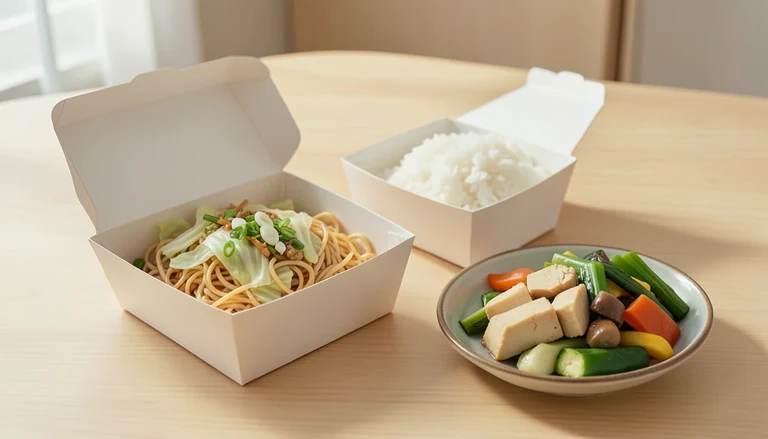
Start with the kind of dish you want
Read a Chinese takeout menu in three passes: choose rice, noodles or a shared dish; choose a preparation and sauce; then confirm the portion and ingredients. Moo goo gai pan points toward sliced chicken and mushrooms, moo shu may offer a filling to wrap in pancakes, and chop suey points toward a mixed stir-fry. Those clues narrow the decision, but the restaurant’s description settles what arrives.
This guide focuses on English names found on US Chinese-American menus. It is a menu decoder, not a ranking of dishes or a claim that every kitchen cooks them alike. If you want a regional specialist’s meal, start with that restaurant’s own specialties rather than treating this list as a complete map of Chinese food.
A useful first question is: “I want a noodle main,” or “We want two dishes to share with rice.” That gives the server a practical starting point. A familiar-sounding chicken dish can still be a large shared plate, while a chef’s-special section may include a complete individual meal.
Use the decoder to choose, then read the description
The chart groups names by the decision they help you make. The recipe descriptions come from their original creators at The Woks of Life; the mixed-protein and noodle examples are checked against Red Tea House’s Pittsburgh menu. They are reference versions rather than fixed definitions for every restaurant.
| If you want… | Look for… | What to confirm |
|---|---|---|
| Sliced chicken with mushrooms | Moo goo gai pan | Which vegetables and sauce? |
| A filling to assemble in pancakes | Moo shu / mu shu | Are pancakes included, and how many? |
| Vegetables and protein in sauce | Chop suey | What accompanies it: rice, noodles or neither? |
| Egg patties with gravy | Egg foo young | Protein, number of patties and gravy ingredients |
| Shrimp in an egg-enriched sauce | Shrimp with lobster sauce | Does this kitchen add pork or other meat? |
| Several proteins on one plate | Happy Family / Triple Delight | Which meats and seafood are actually included? |
| Broad rice noodles | Chow fun | Noodle width, sauce and added ingredients |
| Fine rice noodles | Mei fun | Is this a curry-seasoned Singapore-style version? |
Moo goo gai pan: chicken and mushrooms are the useful clues
The Woks of Life’s Bill Leung translates moo goo gai pan as mushrooms and sliced chicken. His recipe pairs chicken with mushrooms, bok choy, bamboo shoots and water chestnuts in a lightly colored sauce that includes chicken stock and a little oyster sauce. That is a clearer ordering clue than trying to infer a complete dish from the unfamiliar English spelling.
Choose it when the sliced-chicken-and-vegetable combination sounds appealing. Ask whether the restaurant’s version uses a light sauce or a darker one, and whether you can choose the vegetables if a particular texture matters. “Light” can describe a sauce’s appearance; it is not a measured nutrition claim.
When building a small shared order, decide what this plate contributes. If you already chose another chicken-and-vegetable stir-fry, a noodle dish or egg preparation might give the meal more contrast. There is no need to order two similar dishes just because one name sounds more familiar.
Moo shu: check the wrapping kit
Moo shu is worth considering when assembling a small wrap sounds more interesting than spooning sauce over rice. The Woks of Life publishes both an American restaurant version with pancakes and a different pork, egg, cucumber and wood-ear preparation without them. That contrast is why the name alone cannot promise a pancake meal.
Red Tea House’s checked menu describes its moo shu with four crepes, cabbage, carrot, wood-ear mushrooms, bamboo shoots and egg, with vegetable or several protein choices. This is an operator-specific example of the information to look for: wrapper count, filling and sauce, rather than a rule that moo shu always includes four pancakes.
Before ordering for a group, ask whether extra wrappers are available and whether they cost extra. A filling described as vegetables may still include egg. If everyone wants to make a wrap, knowing the wrapper count is more helpful than guessing how many people a “large” container serves.
Chop suey and egg foo young solve different cravings
The Woks of Life’s chop suey example is a chicken-and-vegetable stir-fry with a sauce intended to accompany rice. Its egg foo young guide describes egg patties with vegetables and a chosen protein, served with gravy; the creator gives both a restaurant deep-fried method and a pan-fried alternative. The first choice is a sauced mixed stir-fry; the second makes the egg preparation central.
Ask what the chop suey comes with. Do not assume it is the same noodle dish as chow mein, even when the two sit next to each other on a menu. For egg foo young, ask how many patties make an order and whether the gravy comes separately. These questions are especially useful when splitting an order between people.
If texture is your deciding factor, ask the restaurant to describe its own version: crisp vegetables, softer vegetables, puffy egg patties or a firmer omelet. The dedicated chop suey versus chow mein guide covers that naming problem in more depth, without making this decoder repeat the whole comparison.
Lobster sauce and combination names need a second look
Shrimp with lobster sauce does not reliably mean shrimp plus pieces of lobster. Bill Leung’s original recipe has shrimp, egg, ground pork and chicken stock, with no lobster. He also describes a darker New England variation using fermented black beans. Ask about the actual sauce, especially if you are avoiding pork or expected lobster to be part of the order.
Combination names such as Happy Family and Triple Delight are similarly incomplete ingredient descriptions. Red Tea House names chicken, beef and several seafood items in Happy Family, while its Triple Delight lists chicken, beef and shrimp. Those names express the restaurant’s combination, not an agreed recipe that applies wherever you travel.
For a shared meal, say which ingredients everyone wants rather than ordering the widest combination by default. One diner may welcome shrimp but dislike scallops; another may prefer a single protein. A short ingredient check can be more useful than a long discussion about which dish sounds most impressive.
Keep noodle and sauce comparisons short here
Chow fun and mei fun identify different rice-noodle shapes in the checked Red Tea House menu: broad noodles and fine vermicelli. Both descriptions also list egg. That is a good reminder to read past the noodle name when ingredients matter. Our noodle guide explains how to compare shape, cooking method and broth without assuming that every “chow” or “lo” spelling resolves the whole dish.
For General Tso’s, kung pao, orange and sesame chicken, compare coating, sweetness, chili and additions rather than using the protein to decide. Sauces labeled brown, white or garlic also need a description from the kitchen. A garlic label does not settle whether a sauce is spicy, sweet or suitable for a dietary requirement.
Use the focused comparisons below when one of those is your actual choice. This page’s job is to get you to the right decision, not to make you read eight full articles before placing a takeout order.
Treat the menu as local knowledge
Chinese-American takeout is a cooking tradition in its own right. Bill Leung’s original recipes draw on his family’s US restaurant work, while The Woks of Life’s two moo shu recipes show an American restaurant preparation alongside a different mainland preparation. Those are useful as distinct versions. You can appreciate the takeout tradition while also exploring specific regional cuisines, and ask what a particular kitchen means by a dish instead of treating a difference as a mistake.
For a first order, choose one dish you can describe in ordinary words, then add a contrast if the portions allow. For example: sliced chicken and mushrooms with rice, plus egg patties if the group wants an egg dish. Or choose moo shu because you want wraps, then confirm the pancakes before adding another starch. These are editorial meal ideas, not portion guarantees.
Keep the exact restaurant name and preparation in your notes when you find something you enjoy. Remembering “moo shu with four crepes and this filling” gives you a much better question at the next restaurant than remembering only that an unfamiliar name turned out to be good.
- Is this an individual meal, a lunch combination or a shared plate?
- What comes with it, and what must be ordered separately?
- Is the protein coated and fried, or sliced and stir-fried?
- What are the sauce, stock and filling ingredients?
- Can you describe the noodle shape, heat and texture?
Questions people ask
What is moo goo gai pan?
The name points to mushrooms and sliced chicken. The Woks of Life’s version includes other vegetables in a lightly colored sauce; ask your restaurant which vegetables, stock and sauce it uses.
Does moo shu always come with pancakes?
No. An American restaurant version may include pancakes, while other preparations do not. Confirm whether wrappers are included and how many come with the order.
Does shrimp with lobster sauce contain lobster?
The Woks of Life’s recipe contains no lobster; its sauce uses egg, ground pork and chicken stock. Check the actual restaurant preparation rather than treating the name as an ingredient list.
How do I choose an unfamiliar takeout dish?
Start with the meal format you want, then compare preparation, sauce and texture. Confirm portions, accompaniments and ingredients before ordering.
Menu words in this guide
Last reviewed
Sources & further reading
Background and preparation references. Our descriptions are editorial summaries, not restaurant reviews.
- Red Tea House — Pittsburgh Chinese menu, checked October 3, 2026 (opens in a new tab) ↗
- The Woks of Life — Moo goo gai pan (opens in a new tab) ↗
- The Woks of Life — Restaurant moo shu pork (opens in a new tab) ↗
- The Woks of Life — Moo shu pork without pancakes (opens in a new tab) ↗
- The Woks of Life — Chop suey (opens in a new tab) ↗
- The Woks of Life — Egg foo young (opens in a new tab) ↗
- The Woks of Life — Shrimp with lobster sauce (opens in a new tab) ↗