Choose broad ribbons or fine strands
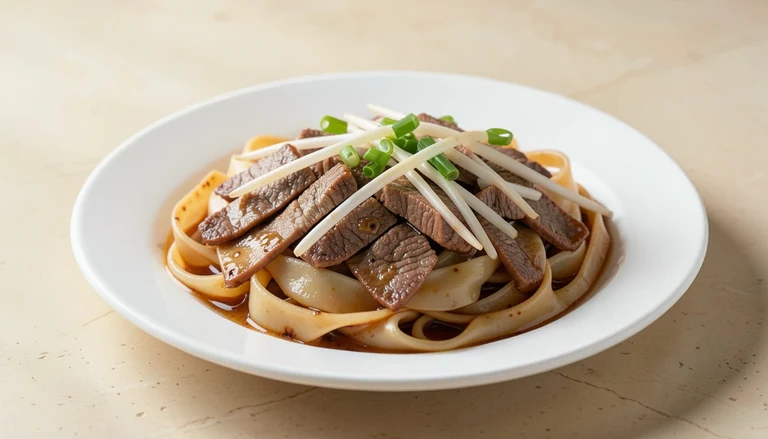
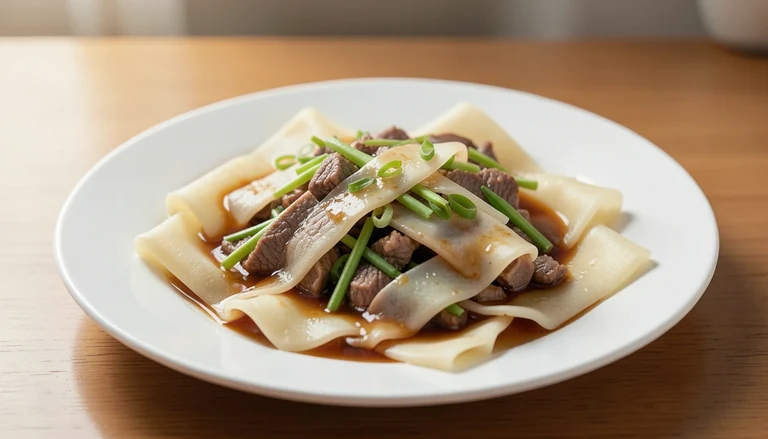
Chow fun usually means a stir-fried dish made with wide, flat rice noodles. Mei fun uses thin rice vermicelli. Choose chow fun when you want broad, slippery ribbons; choose mei fun when you want fine strands mixed through the toppings. Width is the first distinction. Sauce, protein, egg and heat are separate choices.
The Woks of Life’s noodle glossary identifies fresh wide rice noodles as ho fun and thin rice vermicelli as mei fun or mai fun. Ho fun describes the noodle; chow fun on an English restaurant menu usually describes its stir-fried preparation. Spelling varies, so the description “wide flat rice noodles” or “thin rice vermicelli” can resolve an unfamiliar menu label.
| Feature | Chow fun | Mei fun | Useful question |
|---|---|---|---|
| Shape | Broad, flat ribbons | Very thin strands | Which rice noodle does this dish use? |
| Texture to seek | Slippery ribbons with a little chew | A tangle of fine strands | Is this version dry-fried or served with sauce? |
| Preparation example | Beef with bean sprouts and scallions | Singapore curry or Xiamen-style stir-fry | Which seasonings and toppings are included? |
| Heat | Not established by the noodle name | Not established by the noodle name | Is curry or chili part of this version? |
| Ingredients that matter | Sauce and marinade need checking | Sauce, egg and mixed proteins need checking | What is in the complete preparation? |
Chow fun: decide how much sauce you want
Made With Lau’s beef chow fun recipe uses fresh flat rice noodles, beef, onion, bean sprouts and scallions, with soy and oyster sauces. It is a useful example of the Cantonese dry-fried direction. Here dry describes a preparation with little sauce pooling on the plate, rather than a crunchy noodle or an absence of seasoning.
If a menu offers both dry-fried beef chow fun and a version with gravy, choose the serving style you actually want. Ask “Will the sauce coat the noodles or pool around them?” rather than assuming every plate labeled chow fun arrives the same way. Broad noodles can be the format you enjoy even when you choose a different protein or a vegetable preparation.
You do not need to recognize wok hei to make a good first order. Start with the noodle width, the topping and the sauce format. The existing beef chow fun dish page goes further into that specific preparation; this comparison helps you decide whether broad noodles belong in your order at all.
Mei fun: Singapore and Xiamen are different choices
Singapore-style mei fun is a seasoning choice within the thin-noodle family. Bill Leung’s Woks of Life recipe combines rice vermicelli with curry powder, shrimp, char siu, egg and vegetables; it also includes dried chili. The name therefore does not mean a plain noodle dish, and the curry color does not tell you precisely how hot a restaurant makes it.
The same author’s Xiamen chow mei fun uses shrimp, roast pork, ham, egg and vegetables with soy sauce, oyster sauce and sesame oil, without curry powder in the recipe. This offers a contrasting example rather than a guarantee about every dish labeled Xiamen. If you want fine noodles but dislike curry, ask about plain, chicken or Xiamen-style mei fun and check how that kitchen seasons it.
Keep noodle and style separate when ordering: “thin rice noodles, no curry flavor” is clearer than “Singapore noodles without everything spicy.” If the curry-seasoned sauce is already prepared, another mei fun dish may be a better fit than asking staff to rebuild that particular version.
| Preparation | Seasoning direction | Named ingredients in the recipe | What to confirm on a menu |
|---|---|---|---|
| Singapore mei fun | Curry powder with dried chili | Shrimp, char siu, egg and vegetables | Curry, chili level and included proteins |
| Xiamen chow mei fun | Soy and oyster sauces with sesame oil; no curry powder listed | Shrimp, roast pork, ham, egg and vegetables | Whether curry, egg and mixed proteins are included |
Two restaurant menus show how labels work
Chamber Red Chinese Bistro in Saint Charles, Illinois, describes chow fun as wide rice noodles wok-fried with onion, bean sprouts and dark soy sauce. Its ordinary mei fun description names thin rice noodles, egg and vegetables; it lists Singapore mei fun separately as a curry preparation with chicken, shrimp, pork and vegetables. That is a menu where the style modifier carries substantial information.
Hunan Wok in Baltimore has a combined Chow Fan or Mei Fan section, described as wide flat noodles or thin rice noodles. It separately lists Singapore rice noodles with curry sauce and a spicy mark. When two noodle choices share a row, state the width you want instead of relying on the protein name alone.
These are operator descriptions checked for this guide, not taste reports or recommendations to travel. Their useful lesson is how to read your own menu: find the noodle format, then the style, then the included toppings. A short name such as house special still needs an explanation.
Rice noodles do not settle dietary questions
The noodle base and the finished dish are different ingredient questions. The cited beef chow fun includes soy and oyster sauces, while the cited mei fun preparations include egg and combinations of meat or seafood. A rice-noodle label does not establish that the meal fits a gluten restriction or a vegetarian order.
Ask about the exact noodle product, sauces, stock, marinade and toppings when those ingredients affect your choice. For a vegetable order, “Can this be made without egg, meat or seafood ingredients in the sauce?” is more precise than choosing the vegetable version by name. Ask the restaurant to explain the available preparation; do not use the illustration or a short English description as an ingredient list.
Build a simple first comparison
If you are exploring with another diner, my suggestion is to compare dry-fried beef chow fun with a non-curry mei fun preparation, if both are available and suit your ingredients. That changes the width without making curry the only difference you notice. Check portion sizes before ordering two noodle plates, and add a contrasting vegetable rather than another starch if the meal needs it.
For a solo order, let your preferred texture decide first. Choose broad noodles when you want to pick up distinct ribbons, or thin noodles when you want each forkful or chopstickful to mix strands and toppings. Then choose a seasoning direction. Neither width is a dependable signal of calories, chili level or meal size.
If both options sound appealing, save the second format for next time and keep a note of what you ordered. “Wide noodles, dry-fried, beef” is a more useful memory than “the brown noodle plate.” You can change one feature on the next order and learn what you enjoy.
- Name the width: wide flat ribbons or thin rice vermicelli.
- Choose the style: dry-fried, saucy, curry-seasoned or another named preparation.
- Confirm the toppings, sauce ingredients and heat before ordering.
Questions people ask
Is ho fun the same as chow fun?
Ho fun names the wide, flat rice noodle. Chow fun usually names a stir-fried dish using it on an English restaurant menu. Ask about the preparation because the noodle can be served in different ways.
Is mei fun always curry-flavored?
No. Singapore-style mei fun is a curry-seasoned example. The cited Xiamen recipe uses soy and oyster sauces with sesame oil and lists no curry powder.
Which is wider, chow fun or mei fun?
Chow fun uses broad flat ribbons; mei fun uses thin rice vermicelli. If a restaurant uses an unfamiliar spelling, describe the noodle width you want.
Are chow fun and mei fun gluten-free?
Rice noodles alone do not answer that for a finished dish. Ask the restaurant about its exact noodle product, sauces, marinade and preparation; soy sauces and other seasonings vary.
Menu words in this guide
Last reviewed
Sources & further reading
Background and preparation references. Our descriptions are editorial summaries, not restaurant reviews.
- The Woks of Life — Chinese noodles and wrappers (opens in a new tab) ↗
- Made With Lau — Beef chow fun (opens in a new tab) ↗
- The Woks of Life — Singapore mei fun (opens in a new tab) ↗
- The Woks of Life — Xiamen chow mei fun (opens in a new tab) ↗
- Chamber Red Chinese Bistro — Full operator menu (opens in a new tab) ↗
- Hunan Wok, Baltimore — Operator menu (opens in a new tab) ↗