
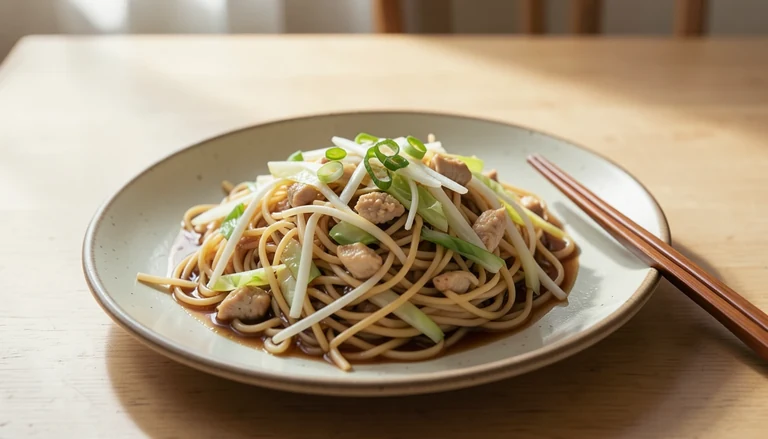
Start with the cooking method, not the menu name
Chow mein and lo mein are both wheat-noodle dishes, and the names describe the cooking before they describe the toppings. Chow mein is stir-fried noodles. Lo mein is noodles that have already been cooked, then tossed or dressed with sauce. Protein, vegetables, heat and price are separate decisions that change from kitchen to kitchen.
The Woks of Life draws the texture line clearly: lo mein noodles are thicker and softer, served soft and moist rather than pan-fried until crispy, while chow mein noodles are thin and dry, cooked until at least a little crisp. Wikipedia makes the same split from the American menu side, describing crispy chow mein as fried flat noodles topped with a thick brown sauce and steamed chow mein as softer noodles mixed with soy sauce.
Treat that as the useful default, not a law. A menu may use chow mein for a plain noodle stir-fry, a crisp noodle cake under sauce, or vegetables with fried noodles on the side. The description beneath the name tells you which one is in front of you.
| Decision | Chow mein / 炒面 (chǎo miàn) | Lo mein / 捞面 (lāo miàn) |
|---|---|---|
| What the name says | Stir-fried noodles | Tossed or stirred noodles |
| Cooking method | Boiled briefly, drained, then pan-fried or stir-fried in a hot wok | Boiled until done, drained, then tossed with sauce or given a short turn in the wok |
| Noodle texture | Thin, dry and partly crisp; can be fully crisp in the Hong Kong style | Thicker, soft, moist and slippery |
| How the sauce sits | Coats the noodles and can brown onto them; a crisp cake may be topped with sauce | Mixed through the noodles, which stay wet and glossy |
| Usual menu context | Cantonese pan-fried noodles; American-Chinese takeout, crisp on the East Coast | Cantonese tossed noodles; American takeout lo mein, often stir-fried with soy sauce |
| Noodle material | Wheat noodles, often egg noodles | Wheat-and-egg noodles, sold thicker |
| English menu names | Chow mein, pan-fried noodles, crispy noodles, Hong Kong style | Lo mein, lomein, tossed noodles, 撈麵 |
Read the characters, then the spelling
The Chinese names are more precise than the English ones. Chow mein is 炒面 in simplified characters and 炒麵 in traditional, chǎo miàn in Mandarin and cháau mihn in Cantonese. Wikipedia glosses it as stir-fried noodles, with 炒 meaning stir-fried and 麵 or 面 meaning noodles.
Lo mein is 捞面 in simplified characters and 撈麵 in traditional, lāo miàn in Mandarin and lou1 min6 in Cantonese. Wikipedia says the term comes from Cantonese 撈麵, meaning stirred noodles, and explains that the character 撈 is used in its casual Cantonese sense of to stir, which differs from its traditional meaning of to dredge or scoop out of water.
The English spellings are a separate history. Wikipedia dates chow mien in American English to 1890 and chow mein to 1903, and attributes the pronunciation to early Taishanese immigrants rather than to Mandarin. That is an etymology, not a recipe lineage: it explains the sound of the English word, not who first fried the noodles.
One shortcut worth discarding is that lo mein is just soft chow mein. The words point at different actions, 炒 for frying and 撈 for tossing, even when an American kitchen blurs the result. Wikipedia is explicit that Cantonese-style lo mein is not traditionally pan-fried or stir-fried; the American takeout version is often stir-fried instead, as in The Woks of Life vegetable lo mein.
How each plate is actually made
The Woks of Life chicken chow mein shows the sequence. Fresh chow mein noodles are boiled for about a minute, drained, rinsed under cold water and spread out to dry. A wok is heated with oil, the noodles are pressed into a thin even layer, left to brown for about two minutes, flipped and browned again. The sauce goes in near the end, then the chicken and vegetables, so the noodles keep their crisp edges.
Made With Lau starts with thick chow mein noodles, steams and boils them, pans them for a minute on each side, then lowers the heat before adding sauce, chicken and vegetables. It finishes with bean sprouts and a drizzle of sesame oil. Different noodles and a different restaurant style, same principle: the noodle meets hot metal before it meets the sauce.
Lo mein reverses the emphasis. The Woks of Life vegetable lo mein boils fresh or uncooked lo mein noodles to al dente, drains and rinses them, then stir-fries garlic, mushrooms, peppers, carrots and greens. The sauce, made from dark and light soy sauce, sesame oil, sugar and optional five spice, is poured over the noodles in the wok and tossed until the color is even. Cooked lo mein egg noodles, which the same site calls oil noodles, skip the boiling step.
The practical result is different sauce behavior. A chow mein noodle that has browned has a dry surface for sauce to cling to, while a lo mein noodle is already wet and slippery, so the sauce coats it rather than soaking in. Neither method is a richer dish by definition; they produce different textures from similar ingredients.
Hong Kong crisp, American takeout soft
In Cantonese cooking, chow mein can mean a pressed cake of noodles pan-fried until the outside is crisp and the inside is still soft, with a saucy topping poured over it. The Woks of Life describes gai see chow mein in exactly those terms. Lo mein in the same tradition is boiled wheat noodles tossed with oyster sauce or served with sauce alongside, often with wontons, char siu or beef brisket.
The American names drifted by region. Wikipedia says East Coast restaurants almost always mean the crispy chow mein, while West Coast restaurants almost always mean the steamed, softer style, and that lo mein is not widely used as a term on the West Coast. At some East Coast restaurants, the soft-noodle dish is listed separately as lo mein.
There is also an American plate that is not really a noodle dish. The Woks of Life describes American chicken chow mein as cooked vegetables in a thick sauce, topped with chicken and fried crispy noodles and served with steamed rice. If that is what your local takeout means, the noodles are a garnish rather than the center of the plate.
Wikipedia notes that crispy chow mein can be served in a hamburger-style bun as a chow mein sandwich, and records Chun King canned chow mein from 1946. Read those as evidence that American chow mein developed its own convenience forms, not as descriptions of Cantonese cooking.
The menus in our own records, read 2026-10-09, show the range. China Palace in Cape Coral lists H19. Chicken Pan Fried Noodle (Hong Kong Chow Mein), a single line that names both the technique and the regional style. Pho Saigon Express in Escondido prints C2 CHOW MEIN CRISPY NOODLES, so the texture is in the item name. Hong Kong Restaurant in Tacoma lists HONG KONG CHOW MEIN with prawns, chicken, mushrooms, water chestnuts and baby corn, and also prints a $2 charge for soft noodles, mushrooms or almonds, so ask which noodle the base price includes.
Order the plate you actually want
Ask about texture first: are the noodles soft throughout, partly crisp, or a solid crisp cake? Then ask whether the sauce is tossed through the noodles or poured on top. Those two answers separate most chow mein and lo mein plates faster than the English name does.
If you want lo mein's soft noodle, say soft rather than ordering chow mein and hoping. If you want crunch, do not order lo mein expecting the kitchen to crisp it, because lo mein noodles are boiled before they reach the wok. When a menu offers both, the lo mein line is usually the softer plate and the chow mein line is the one that may be crisp.
Ask what comes with the dish. American chicken chow mein may arrive with rice because the noodles are a topping, while a noodle-centered chow mein may be the starch for the table. A lo mein order may be a full portion or a side, and a quoted price may be a starting amount before protein or size.
Both dishes use wheat noodles rather than rice noodles. Cantonese lo mein is described as flour-and-egg noodles, and the Hong Kong-style noodles used for chow mein are often egg noodles too. If you need rice noodles, look for chow fun, which is made from wide flat rice noodles, and check the sauces separately because a rice-noodle name does not make the finished plate safe for a gluten restriction.
For takeout, ask whether crisp noodles and sauce are packed separately. A separated bag lets you keep the texture you ordered, since noodles that sit in sauce on the way home will soften. That is a question about packaging, not a promise about any particular restaurant.
Six menus that print the distinction
Springfield's New China lists 27. Vegetable Lo Mein 菜捞面 for $9.95 on its operator menu read 2026-10-09, pairing the English name with 捞 and 面. Chang's Wok in Olathe prints 24. Vegetable Lo Mein 菜撈麵 for $12.25 as a starting price, using traditional characters, on its menu checked 2026-10-09.
Noodle Master, at a Las Vegas address listed in the Henderson guide, prints Veggie Chow Mein 蔬菜炒面 for $14.03 on a BeyondMenu listing re-read 2026-11-03. That is the clearest chow mein line in our records with 炒 characters attached.
Three more menus show how far the English can travel. China Palace in Cape Coral writes Chicken Pan Fried Noodle (Hong Kong Chow Mein), Pho Saigon Express in Escondido writes CHOW MEIN CRISPY NOODLES, and Hong Kong Restaurant in Tacoma writes HONG KONG CHOW MEIN and then prices soft noodles as an add-on, on menus read 2026-10-09. Each is an operator menu read 2026-10-09, not a review or a recommendation.
In the city records behind this guide, 40 restaurants quote a lo mein plate in their listed prices and 39 quote a chow mein plate. That is a count of our own dated menu reads, not a national survey, and we have not visited any of these restaurants.
Hold the decision in one sentence
Choose chow mein for noodles that have met hot metal and may be browned or crisp, and choose lo mein for soft noodles dressed with sauce. Ask about soft versus crisp and sauce on top versus tossed through. If the menu says Hong Kong style, expect the pan-fried direction; if it says lo mein, expect boiled noodles and a wetter plate.
Everything else on the menu stays open. The protein, vegetables, chili and portion are separate choices, and a restaurant that blurs the two names is following a menu habit rather than rewriting the technique. Ordering by texture and sauce gets you the plate you wanted even when the words disagree.
Questions people ask
What is the difference between chow mein and lo mein?
Chow mein is stir-fried noodles, and the noodles often turn partly crisp in the wok. Lo mein is noodles that have been boiled, then tossed or dressed with sauce, so they stay soft and slippery. The names describe the cooking, not the protein or vegetables.
Is chow mein always crispy?
No. Wikipedia says East Coast restaurants almost always mean the crispy chow mein, while West Coast restaurants almost always mean the steamed, softer style. Some menus also list soft noodles as an option on a chow mein line.
Is lo mein just soft chow mein?
Not in the names. 炒 means stir-fried and 撈 means tossed, and Wikipedia says Cantonese-style lo mein is not traditionally pan-fried or stir-fried. American takeout lo mein is often stir-fried, so a particular plate can resemble chow mein even when the word does not.
Are chow mein and lo mein wheat noodles?
Both dishes use wheat noodles rather than rice noodles; Cantonese lo mein is described as flour-and-egg noodles, and chow mein noodles are often egg noodles too. If you need rice noodles, look for chow fun and ask about the sauces, because the noodle alone does not settle a gluten question.
Why does chow mein come with rice on some menus?
The Woks of Life describes American chicken chow mein as vegetables in a thick sauce with chicken and fried crispy noodles, served with steamed rice. In that format the noodles are a topping, so the rice is the starch rather than an extra side.
How do I ask for soft noodles or a crisp noodle cake?
Ask whether the noodles are soft throughout, partly crisp, or a solid crisp cake, and whether the sauce is tossed through or poured on top. Hong Kong Restaurant in Tacoma printed a $2 charge for soft noodles, mushrooms or almonds on its menu checked 2026-10-09, so confirm which noodle the base price includes.
Menu words in this guide
Last reviewed
Sources & further reading
Background and preparation references. Our descriptions are editorial summaries, not restaurant reviews.
- Wikipedia — Chow mein (opens in a new tab) ↗ read
- Wikipedia — Lo mein (opens in a new tab) ↗ read
- The Woks of Life — Chicken chow mein (opens in a new tab) ↗ read
- The Woks of Life — Vegetable lo mein (opens in a new tab) ↗ read
- The Woks of Life — Chinese noodles and wrappers (opens in a new tab) ↗ read
- Made With Lau — Chicken chow mein (opens in a new tab) ↗ read
- New China, Springfield — operator menu, read 2026-10-09 (opens in a new tab) ↗
- Chang's Wok, Olathe — operator menu, read 2026-10-09 (opens in a new tab) ↗
- Noodle Master, Las Vegas address — BeyondMenu listing, re-read 2026-11-03 (opens in a new tab) ↗
- China Palace, Cape Coral — operator menu, read 2026-10-09 (opens in a new tab) ↗
- Pho Saigon Express, Escondido — operator menu, read 2026-10-09 (opens in a new tab) ↗
- Hong Kong Restaurant, Tacoma — operator menu, checked 2026-10-09 (opens in a new tab) ↗