Beef chow fun
干炒牛河
Gān chǎo niú hé
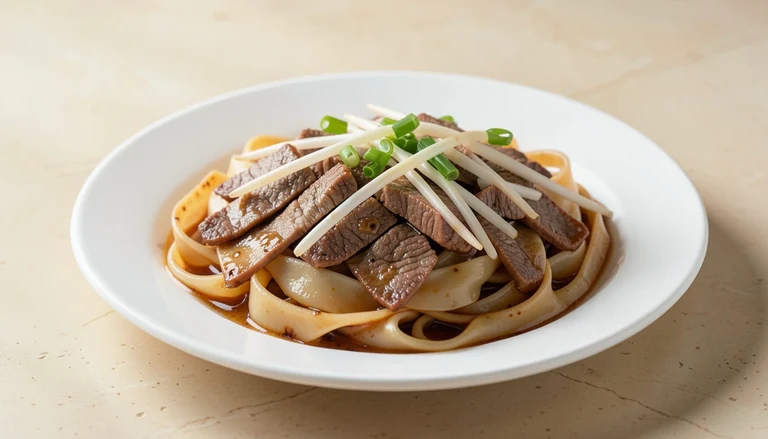
Wide rice noodles wok-fried with beef, bean sprouts and scallions.
| Fact | Detail |
|---|---|
| Heat | Mild |
| Main protein | Beef |
| Region | Cantonese |
| Common menu names | Beef chow fun, dry-fried (gon chaau) |
Gon chow ngau ho, and a noodle from Shahe
Beef chow fun is 乾炒牛河, gān chǎo niú hé in Mandarin and gon chow ngau ho in Cantonese. Wikipedia gives the four characters and translates them as dry fried beef Shahe noodles. (Wikipedia — Beef chow fun (opens in a new tab), read ) Made With Lau reads the name one character at a time: 乾 dry, 炒 stir-fry, 牛 beef, 河 flat rice noodle. (Made With Lau — Beef chow fun (opens in a new tab), read )
Wikipedia describes the plate as a Cantonese staple of stir-fried beef, wide rice noodles and bean sprouts, served in yum cha rooms in Guangdong and Hong Kong, in cha chaan tengs, and overseas. (Wikipedia — Beef chow fun (opens in a new tab), read ) The Woks of Life defines it as a Cantonese dish made by stir-frying beef, wide rice noodles, scallions, ginger, bean sprouts and dark soy sauce. (The Woks of Life — Beef chow fun (opens in a new tab), read )
The noodle has its own history. Wikipedia says shahe fen is a wide rice noodle named for Shahe, a town that is now part of Guangzhou’s Tianhe District, and that it is sold fresh in strips or sheets that a cook can cut to width. (Wikipedia — Shahe fen (opens in a new tab), read ) Made With Lau says the town is where this style of flat rice noodle was first made. (Made With Lau — Beef chow fun (opens in a new tab), read )
A menu may print ho fun, hor fun, he fen or shahe fen for the noodle, and chow fun for the stir-fried dish. Wikipedia records those spellings and says chow fun is the name North American Chinese restaurants use most often. (Wikipedia — Shahe fen (opens in a new tab), read )
Wikipedia follows the same noodle across borders. It records ho fun and hor fun as Cantonese transliterations of shahe fen, guotiao and kway teow as names in Minnan and Southeast Asia, and says Vietnamese pho noodles are likely derived from the Chinese noodle. (Wikipedia — Shahe fen (opens in a new tab), read )
The wide rice noodle has relatives that are not interchangeable. Wikipedia says Minnan cooks treat shahe fen and kway teow as different foods: hor fun is thinner, more porous and takes up sauce, while guotiao is denser and starchier and needs a longer soak. (Wikipedia — Shahe fen (opens in a new tab), read ) That is why the same width of noodle behaves so differently in two dishes. (Wikipedia — Shahe fen (opens in a new tab), read )
A hot wok, a quick hand, and beef that was marinated first
Wikipedia gives the method in one paragraph: marinate the sliced beef, sear it in a wok, add the noodles, other ingredients and sauce, then stir-fry the bean sprouts until tender. It says the sear is how the dish gets its wok hei. (Wikipedia — Beef chow fun (opens in a new tab), read )
The Woks of Life marinates flank steak with water, baking soda, cornstarch, oyster sauce, Shaoxing wine and soy sauce for at least 30 minutes, and says the baking soda tenderises the meat toward the texture of a restaurant version. The wok is heated until it smokes. The beef is seared and taken out. Ginger and scallion go into the oil, then the noodles, then Shaoxing wine around the rim of the wok, the soy sauces, sesame oil, sugar and the beef. Bean sprouts go in last and are cooked only until just tender. (The Woks of Life — Beef chow fun (opens in a new tab), read )
Made With Lau follows the same shape with a different sauce. Its chow fun sauce is tamari, soy sauce and oyster sauce. The marinade adds white pepper, sugar, cooking wine and oil to the baking soda and cornstarch. The beef cooks for 40 to 60 seconds before it comes out, and the noodles get about two minutes alone in the wok before the sauce goes in. (Made With Lau — Beef chow fun (opens in a new tab), read )
Both pages treat restraint as technique. The Woks of Life says continuous movement of the noodles keeps them from sticking and whole, and that a metal spatula works if the toss feels like too much. (The Woks of Life — Beef chow fun (opens in a new tab), read ) Made With Lau says the more the noodles are flipped and stirred, the more they break, and it lists tearing apart stuck noodles among its three common mistakes. (Made With Lau — Beef chow fun (opens in a new tab), read ) Wikipedia makes the same point, then calls the dish a major test for cooks in Cantonese kitchens because the heat, the oil and the handling all have to be right at once. (Wikipedia — Beef chow fun (opens in a new tab), read )
Dry-fried, wet-fried, and the noodle in between
Wikipedia separates two methods. Dry-fried hor fun is fried with condiments such as soy sauce. Wet-fried hor fun is finished with a thickening sauce, usually with seafood, while the dry version usually carries beef or chicken. The article says the dry method is now common enough that a menu may print only hor fun and still mean the dry plate. (Wikipedia — Beef chow fun (opens in a new tab), read )
The Woks of Life describes the same split from the kitchen side. Its main recipe is the dry version, and a separate saucy beef chow fun recipe sits beside it on the same site. (The Woks of Life — Beef chow fun (opens in a new tab), read ) Made With Lau says a saucier version exists and that gon refers to the absence of a sauce puddle. (Made With Lau — Beef chow fun (opens in a new tab), read )
The noodle decides how the plate behaves. Wikipedia says shahe fen is white, broad and slightly slippery, with an elastic, chewy texture, and that it does not freeze or dry well, which is why it is usually bought fresh. (Wikipedia — Shahe fen (opens in a new tab), read ) The Woks of Life prefers very fresh noodles when it can find them, warns that refrigerated or vacuum-sealed fresh noodles stick together and resist stir-frying, and uses thicker dried rice noodles soaked overnight as its more consistent option. Stiff fresh noodles get about 30 seconds in boiling water and then an ice bath. (The Woks of Life — Beef chow fun (opens in a new tab), read )
Made With Lau loosens fresh noodles by hand before the wok, refuses to freeze them, and microwaves refrigerated ones for a minute before frying. (Made With Lau — Beef chow fun (opens in a new tab), read ) That is a third answer to the same problem. The noodle a cook can buy sets the method.
What the menu line leaves open
Ask for the dry plate or the gravy one first. Wikipedia’s dry-fried version is seasoned with soy and other condiments, while the wet version is thickened and usually carries seafood. (Wikipedia — Beef chow fun (opens in a new tab), read ) The Woks of Life keeps both recipes, so the English name does not settle which one the kitchen means. (The Woks of Life — Beef chow fun (opens in a new tab), read )
The protein is the next question. Wikipedia says dry-fried hor fun usually means beef or chicken, and that other chow fun preparations exist under the same noodle name. (Wikipedia — Beef chow fun (opens in a new tab), read ) Bean sprouts are common but not the only vegetable: Made With Lau adds yellow onion, and the Woks of Life uses scallion and ginger. (Made With Lau — Beef chow fun (opens in a new tab), read ) (The Woks of Life — Beef chow fun (opens in a new tab), read )
Dietary questions are about the sauces, not the noodle. The Woks of Life marinade and sauce use soy sauce and oyster sauce, and Made With Lau uses soy sauce, oyster sauce and tamari. (The Woks of Life — Beef chow fun (opens in a new tab), read ) (Made With Lau — Beef chow fun (opens in a new tab), read ) A rice-noodle dish is not automatically wheat-free.
The San Mateo guide lists a checked menu line written Beef Chow Fun, and the Naperville guide lists one written the same way. Those are menu names from the city guides, not a judgment of the cooking. Cantonese cooking is the regional page, wok hei is the technique entry, the chow fun versus mei fun guide separates the wide noodle from rice vermicelli, and the noodle guide places it among other bowls.
Regional versions
- Dry-fried, the Cantonese default. Wikipedia says hor fun can be dry-fried with condiments such as soy sauce or wet-fried with a thickening sauce, and that the dry method is common enough now that a menu may print only hor fun. (Wikipedia — Beef chow fun (opens in a new tab), read ) That recipe’s sauce is soy sauce, dark soy, sesame oil and a little sugar, with Shaoxing wine added at the wok. (The Woks of Life — Beef chow fun (opens in a new tab), read )
- Wet-fried with gravy. Wikipedia says the wet-fried version usually includes seafood while the dry-fried one usually carries beef or chicken. (Wikipedia — Beef chow fun (opens in a new tab), read ) The Woks of Life links a saucy beef chow fun as its own recipe beside the dry plate. (The Woks of Life — Beef chow fun (opens in a new tab), read )
- Fresh noodles or dried. Wikipedia says shahe fen does not freeze or dry well, so it is usually bought fresh in strips or sheets. (Wikipedia — Shahe fen (opens in a new tab), read ) The Woks of Life uses very fresh noodles when a shop has them, then recommends thicker dried rice noodles soaked overnight for consistency. (The Woks of Life — Beef chow fun (opens in a new tab), read ) Made With Lau separates fresh noodles by hand and says not to freeze them. (Made With Lau — Beef chow fun (opens in a new tab), read )
- Beef, chicken or seafood. Wikipedia says dry-fried hor fun usually means beef or chicken, and that wet-fried hor fun usually means seafood. (Wikipedia — Beef chow fun (opens in a new tab), read ) Its noodle article describes chao fen as shahe fen stir-fried with meat, vegetables or both, which leaves the protein as a separate choice. (Wikipedia — Shahe fen (opens in a new tab), read )
Questions people ask
What does dry-fried mean on a chow fun menu?
Made With Lau reads gon (乾) as dry and says the plate should not have a big puddle of sauce pooling at the bottom; it also notes that a saucier version exists. (Made With Lau — Beef chow fun (opens in a new tab), read ) Wikipedia separates dry-fried hor fun, cooked with condiments such as soy sauce, from wet-fried hor fun, finished with a thickening sauce. (Wikipedia — Beef chow fun (opens in a new tab), read )
What is wok hei?
The Woks of Life defines wok hei (鑊氣) as the breath of the wok: the seared, savoury flavour that comes from cooking over very high heat. It says a home burner makes the effect harder to reach but does not make it impossible. (The Woks of Life — Beef chow fun (opens in a new tab), read ) Wikipedia calls wok hei an important factor in this dish and says the noodles must be stirred quickly and not handled too strongly or they break. (Wikipedia — Beef chow fun (opens in a new tab), read )
Is beef chow fun gluten-free?
Not by default. The noodles are rice, but the Woks of Life marinade and sauce use soy sauce and oyster sauce. (The Woks of Life — Beef chow fun (opens in a new tab), read ) Made With Lau uses tamari, which it describes as containing little or no wheat, alongside regular soy sauce and oyster sauce in the same dish. (Made With Lau — Beef chow fun (opens in a new tab), read ) Ask which sauces the kitchen uses and whether it stocks wheat-free versions.
Where does the name beef chow fun come from?
Made With Lau says the noodle style was first made in Shahe, a town in Guangzhou, and reads the Cantonese name 乾炒牛河 as dry (乾), stir-fry (炒), beef (牛) and flat rice noodle (河). (Made With Lau — Beef chow fun (opens in a new tab), read ) Wikipedia says the noodle is believed to have originated in the town of Shahe, now part of Tianhe District, and takes its name from there. (Wikipedia — Shahe fen (opens in a new tab), read )
Is chow fun the same as chow mein?
No. Made With Lau says chow fun calls for rice noodles while lo mein typically uses egg noodles. (Made With Lau — Beef chow fun (opens in a new tab), read ) Wikipedia calls chao fen a stir-fry of wide rice noodles and says North American Chinese restaurants most often print the Cantonese-derived name chow fun. (Wikipedia — Shahe fen (opens in a new tab), read ) The chow fun versus mei fun guide separates the wide noodle from thin rice vermicelli.
Keep reading
Last reviewed
Where to eat beef chow fun
From each restaurant’s checked menu; call ahead — menus change.
Chinese food in Torrance
- Mandarin KitchenBeef Chow Fun · Torrance Boulevard, 2526 block
Chinese food in Renton
- Mai Place Asian BistroDry Chow Fun with Beef · 3152 Northeast Sunset Boulevard
- Golden Peacock RestaurantBeef Chow Fun · Southeast Petrovitsky Road
Chinese food in San Mateo
- Bao ExpressBeef Chow Fun · Park Place
Chinese food in Daly City
- Red Bowl Noodles (Mission Street)Beef Chow Fun · Mission Street
Chinese food in Sunnyvale
- Asia Village RestaurantBeef Chow Fun · S Wolfe Road
Chinese food in Naperville
- Zens NoodlesBeef Chow Fun · East Ogden Avenue
Chinese food in Chandler
- Phoenix PalaceBeef Chow Fun · Dobson Road, Dobson Park Plaza
- Wok with MingBeef Chow Fun · W Chandler Boulevard
Chinese food in Quincy
- Ming SeafoodBeef Chow Fun · Hancock Street
Chinese food in Plano
- Royal KitchenBeef Chow Fun · Independence Parkway
Chinese food in Miami
- Sang's Chinese Food and Dim SumBeef Chow Fun · NE 163rd Street, North Miami Beach
Chinese food in Sacramento
- Nathan's Chinese CuisineBeef Chow Fun · Bruceville Road, Elk Grove
Chinese food in Honolulu
- Lam's KitchenBeef Chow Fun · Maunakea Street, Chinatown
Sources & further reading
Background and preparation references. Our descriptions are editorial summaries, not restaurant reviews.