
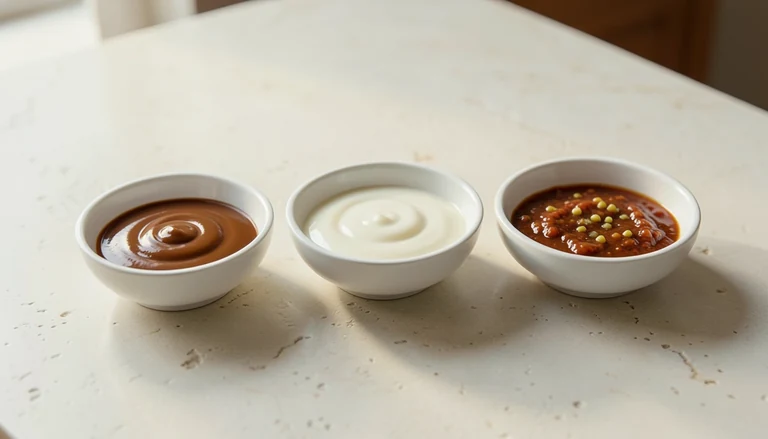
The three names describe overlapping choices
Chinese brown sauce usually means a savory stir-fry sauce colored by soy sauce; white sauce points to a paler stock-based preparation. Garlic sauce emphasizes a flavor and can be pale, brown or spicy. These are menu families, not three universal recipes, and their color does not establish whether a dish meets your ingredient requirements.
For a concrete operator example, 5 Spice Fusion's vegetable side choices include minced garlic sauce described as white, brown sauce, and spicy garlic sauce described as brown. Garlic therefore does not belong to one fixed color category even on that single menu.
Choose by the flavor you want, then clarify the kitchen's preparation. Ask whether it is savory and soy-forward, more delicately seasoned, garlicky without chili, or sweet-tangy and spicy. A description such as light sauce should prompt a question about flavor, amount or texture rather than a nutritional conclusion.
| Menu family | Useful flavor question | Useful texture question | Ingredients to ask about |
|---|---|---|---|
| Brown sauce | Is it mostly savory, or noticeably sweet? | Will it lightly coat the food or include extra gravy? | Soy and oyster sauces, stock, wine and the full seasoning mixture |
| White sauce | Is this mild in chili heat, and what aromatics does it use? | Is it clear and glossy, or a thicker pale sauce? | Stock, oyster sauce, sesame, wine and any soy ingredients |
| Garlic sauce | Is it chili-free, spicy, or sweet and sour? | Is it a coating, a gravy, or a separate sauce? | Chili or bean paste, stock, soy or oyster sauce, vinegar and sugar |
| Fish-fragrant / yuxiang | Is this the house yuxiang preparation? | How much sauce accompanies the dish? | The full recipe, including any fish sauce, meat or animal stock |
Brown sauce: look beyond the color
Bill Leung's all-purpose stir-fry sauce at The Woks of Life supplies a specific brown-sauce example. It combines chicken stock, light and dark soy sauces, oyster sauce, Shaoxing wine, sugar, sesame oil and white pepper, with cornstarch used when finishing a stir-fry. He identifies soy sauce, especially dark soy, as the source of the amber color.
That example explains why brown sauce can be useful with a range of proteins and vegetables. It does not mean every brown sauce contains that list or the same proportions. A darker appearance cannot tell you how salty, sweet or thick your restaurant's version will be.
If the dish you want is usually served in another sauce, ask whether this kitchen can prepare it with brown sauce. Bill describes doing that for customers in his restaurant experience, but substitutions at your chosen restaurant need their own confirmation. Ask about the whole dish, including its marinade; changing the finishing sauce may not change earlier seasoning.
White sauce: pale does not mean unseasoned
The Woks of Life's white sauce offers a contrasting recipe: stock with garlic, ginger, scallion, white pepper and sesame oil, plus salt, sugar and a small amount of oyster sauce or its vegetarian alternative. It is thickened when used in a stir-fry. The recipe allows chicken, pork or vegetable stock, so the words white sauce cannot identify the stock on their own.
Grace Garden in Gilbert, Arizona, explicitly labels its moo goo gai pan as white sauce on the operator's menu. That is an example of how a menu helps you find a pale-sauce dish, rather than proof of every ingredient in the kitchen's version.
If you want the sauce to leave more attention on the mushrooms, greens or protein, ask which preparation the restaurant recommends. If you want less sauce, say that separately. Mild flavor, a small quantity of sauce and a particular nutritional profile are different requests; one word cannot reliably communicate all three.
Garlic sauce is broader than yuxiang
Yuxiang, written 鱼香 and often translated as fish-fragrant, is a named Sichuan flavor direction. Judy Leung's pork with garlic sauce at The Woks of Life is identified as yuxiang rousi. Her example combines garlic and ginger with spicy bean sauce, dried chilies, vinegar, sugar and soy sauce. This is a more specific preparation than simply adding extra garlic to a pale stir-fry sauce.
A garlic-sauce label by itself does not prove the restaurant means yuxiang. The pale minced-garlic and spicy brown garlic choices on 5 Spice Fusion's menu show why you should ask whether the dish is sweet-tangy and spicy or uses a simpler garlic seasoning.
Fish-fragrant is a flavor name rather than a request for a fish dish. It also cannot guarantee seafood-free ingredients: The Woks of Life's fish-fragrant eggplant recipe lists optional fish sauce as well as oyster sauce, chicken stock and ground meat. Ask about the particular preparation when those ingredients matter.
Make sauce questions specific to your order
Use a dish name and one preference: 'For the broccoli and chicken, which sauce is garlicky without chili?' or 'Can the tofu and vegetables come with your spicy, tangy garlic sauce?' This lets the staff answer from the kitchen's actual options rather than interpret a broad request for the best sauce.
When ingredients are a requirement, state that requirement before choosing. Ask about the stock, sauces, marinade and cooking process together. A vegetable main ingredient does not identify the liquid or seasoning used around it, and a requested omission may not be possible in a sauce prepared in advance.
If sauce on the side sounds useful, ask whether it is possible for this dish. Some preparations depend on cooking food with the sauce, so a separate cup may not produce the meal you had in mind. Decide with the kitchen rather than treating a delivery-app note as confirmation.
For a shared order, my suggestion is to choose one sauce-led dish, then look for a different texture or seasoning in another dish. If the whole table prefers the same sauce, order that deliberately. The useful comparison is how the plates fit your meal, not which color is supposedly healthier.
Questions people ask
What is Chinese brown sauce made of?
There is no universal formula. The Woks of Life's example uses stock, soy and oyster sauces, wine and other seasonings, with starch added for a stir-fry. Ask your restaurant about its own sauce and the full dish preparation.
Is Chinese white sauce vegetarian?
Color does not establish that. The Woks of Life's white-sauce recipe permits animal or vegetable stock and regular or vegetarian oyster sauce. Ask the kitchen which ingredients and preparation it uses.
Is Chinese garlic sauce spicy?
It can be, but the name alone does not settle it. 5 Spice Fusion distinguishes pale minced garlic sauce from spicy brown garlic sauce. Ask about chili and the flavor of the specific sauce you are ordering.
Is garlic sauce the same as fish-fragrant sauce?
Some English labels use garlic sauce for yuxiang preparations; other garlic sauces are different. Ask whether the kitchen means yuxiang and clarify its ingredients. The fish-fragrant name alone does not establish whether a recipe contains seafood seasonings.
Menu words in this guide
Last reviewed
Sources & further reading
Background and preparation references. Our descriptions are editorial summaries, not restaurant reviews.
- The Woks of Life — Bill Leung's brown stir-fry sauce (opens in a new tab) ↗
- The Woks of Life — Bill Leung's Chinese white sauce (opens in a new tab) ↗
- The Woks of Life — Judy Leung's pork with garlic sauce / yuxiang rousi (opens in a new tab) ↗
- The Woks of Life — Fish-fragrant eggplant and optional fish sauce (opens in a new tab) ↗
- 5 Spice Fusion — Operator menu sauce choices (opens in a new tab) ↗
- Grace Garden, Gilbert — Operator menu and white-sauce moo goo gai pan (opens in a new tab) ↗