Mapo tofu
麻婆豆腐
Má pó dòu fu
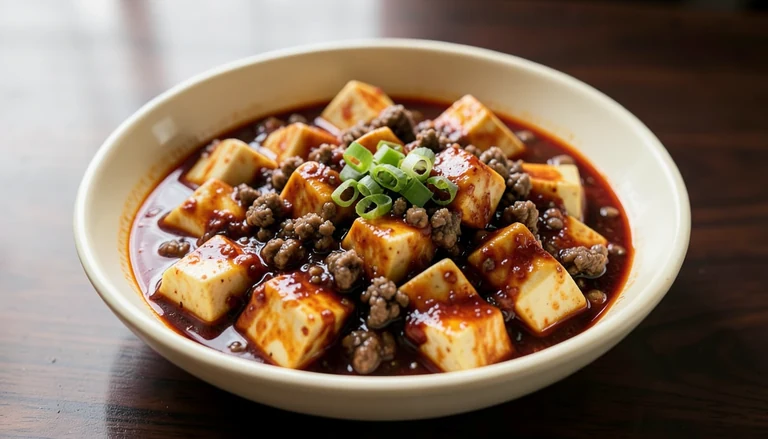
Soft tofu, a deeply savory sauce, and the distinctive tingle of Sichuan pepper.
| Fact | Detail |
|---|---|
| Heat | Hot |
| Main protein | Tofu; pork or beef is common |
| Region | Sichuan |
| Common menu names | Mapo tofu |
Mapo doufu, pockmarks and a red sauce
Mapo tofu is 麻婆豆腐, Má pó dòu fu on this site. Wikipedia records the pinyin mápó dòufu and the literal reading pockmarked old woman beancurd. Ma, it says, stands for mázi (麻子), pockmarks. Po is the first syllable of pópo (婆婆), an old woman or grandma. (Wikipedia — Mapo tofu (opens in a new tab), read )
The same article calls it a Sichuan dish: tofu set in a spicy sauce, typically a thin, oily, bright-red suspension based on douban (fermented broad-bean and chili paste) and douchi (fermented black beans), with minced meat, traditionally beef. It says the dish likely began at a Chengdu restaurant in the 1860s or 1870s. Variations it lists add water chestnuts, onions, other vegetables or wood ear fungus. (Wikipedia — Mapo tofu (opens in a new tab), read ) China Sichuan Food describes the plate as soft tofu, ground meat, doubanjiang, fermented black beans, garlic, ginger and ground Sichuan pepper, hot and numbing. (China Sichuan Food — Mapo tofu (opens in a new tab), read )
Fry the paste, then let the tofu sit
The two recipe pages do not use one tofu or one meat. They do share an order: season the mince, cube the tofu, fry the doubanjiang so the oil reddens, simmer, thicken, and finish with Sichuan pepper.
China Sichuan Food seasons minced beef or pork with salt and white pepper, cubes soft tofu at about 2 centimeters, and blanches the cubes for a minute in salted boiling water, which the page says pulls off a raw soy taste. The mince is fried until crisp and set aside. Doubanjiang then fries for about a minute over low heat until the oil is red. Fermented black beans, garlic, the white of the scallion and ginger follow. Stock or water, light soy and a little sugar go in, then half the cooked meat, and the tofu simmers about 6 to 8 minutes so it takes on the sauce. A cornstarch slurry goes in two additions, with the pot pushed rather than stirred, so the cubes stay whole. Sesame oil and the rest of the crisp meat finish the pot. Ground Sichuan pepper and chopped garlic greens go on at the table. The page says cooks in Sichuan reach for garlic greens rather than scallion greens, and that scallion can stand in. (China Sichuan Food — Mapo tofu (opens in a new tab), read )
The Woks of Life starts the oil with fresh and dried chilies, then ginger, garlic and ground pork. Ground Sichuan pepper goes in after the pork, because the page found that frying the powder earlier burns it and turns it bitter. Spicy bean sauce, which is doubanjiang, colors the pot. A little broth, a cornstarch slurry and the chili oil come next, then silken tofu, moved gently for 3 to 5 minutes. Sesame oil and a pinch of sugar are optional. Scallion wilts in at the end, and more pepper can be sprinkled on the plate. The page says the amount of pepper should drop when the peppercorns are very fresh, and that burned or seedy peppercorns taste bitter. (The Woks of Life — Mapo tofu (opens in a new tab), read )
Wikipedia’s description of the flavor uses seven words cooks reach for: má (麻, numbing), là (辣, hot), tàng (烫, hot in temperature), xiān (鲜, fresh), nèn (嫩, tender), xiāng (香, aromatic) and sū (酥, flaky). It lists Pixian chili broad-bean paste, fermented black beans, chili oil, chili flakes, Sichuan peppercorns, garlic, ginger and green onion as the ingredients that give the dish its taste, with stock, sugar and starch as supplements. Sugar, it says, depends on how salty the bean paste is. (Wikipedia — Mapo tofu (opens in a new tab), read ) Doubanjiang is the paste. Sichuan peppercorn is the numbing half, which is not the chili.
A shop story, and a recipe that changed
Wikipedia ties the history to Chen Mapo restaurant in Chengdu. It says the shop opened in 1862, or in 1874, as a Fanpu eatery named Chenxingsheng, run by a couple named Chen near Wanfu bridge. According to Li Jieren, on that page, Mrs. Chen’s first version used chili, pork, tofu and Sichuan pepper. In the 1920s the restaurant hired Xue Xiangshun, who cooked it with beef instead of pork and added douchi. (Wikipedia — Mapo tofu (opens in a new tab), read )
China Sichuan Food tells a shorter kitchen story. A couple ran a restaurant that mainly sold vegetarian dishes. The wife, the cook, had pocks on her face. Guests asked for meat, she added beef to the tofu, and the plate took her nickname. The page says mapo means a woman with pocks on her face. (China Sichuan Food — Mapo tofu (opens in a new tab), read ) The two accounts share the nickname and the city. They do not share the first meat, or the moment douchi entered the pot. Both stay.
The paste is not stable across the written record either. Wikipedia says the first published recipe, in a 1950s national collection titled 中国名菜谱, did not include Pixian doubanjiang and relied on douchi. The same article’s account of the dish as it is cooked now puts Pixian chili broad-bean paste among the necessary ingredients. (Wikipedia — Mapo tofu (opens in a new tab), read ) China Sichuan Food calls doubanjiang the essential paste for the Sichuan plate and fries it until the oil reddens. (China Sichuan Food — Mapo tofu (opens in a new tab), read ) A menu that says mapo has not told you which of those sauces is in the pot.
What a US menu line does not settle
Wikipedia says the dish is usually adapted outside Sichuan, and that in the West the heat is often turned down so more people will order it, particularly at Chinese restaurants that do not specialize in Sichuan cooking. It also says meatless versions are common, with shiitake or other mushrooms, or a plant-based substitute. Pickled vegetables, zha cai or ya cai, can go into the meatless pot or the meat pot. They are optional on that page. (Wikipedia — Mapo tofu (opens in a new tab), read )
The Woks of Life makes the same point from the takeout side. It says the dish spread out of Sichuan and that restaurants and takeout kitchens put their own spin on it, often lessening the spice and adding vegetables until the plate is a different dish. In the recipe it still treats spicy bean sauce and Sichuan pepper as the two ingredients that cannot be swapped out if the plate is going to be the Sichuan one. (The Woks of Life — Mapo tofu (opens in a new tab), read ) China Sichuan Food’s meatless note is narrower: skip the mince, or use dried or fresh mushrooms. (China Sichuan Food — Mapo tofu (opens in a new tab), read )
Spellings on US menus include Mapo, Ma Po and Mo Po. They are transcriptions. The Tampa guide shows two different lines: Mapo Tofu filed in a vegetable section whose description names no protein, and Ma Po Tofu (with minced pork) on another menu. The New York guide includes Ma Po Tofu with Pork. Those are checked names in the city guides, not a ranking of the restaurants. Ask about meat, stock, and whether the pepper is in the pot as well as the chili. Sichuan cooking is the regional page. The Sichuan ordering guide builds a first meal around this plate, and the vegetarian ordering guide is the one that treats a tofu title as a question, not an answer.
Regional versions
- Chengdu sauce with beef. Wikipedia describes a thin, oily, bright-red sauce of douban and douchi with minced meat, traditionally beef. (Wikipedia — Mapo tofu (opens in a new tab), read ) China Sichuan Food fries the beef until it crisps, sets it aside, and returns part of it to the sauce and the rest at the end. (China Sichuan Food — Mapo tofu (opens in a new tab), read )
- Pork, including the early plate. Wikipedia, citing Li Jieren, says the first version associated with Mrs. Chen used chili, pork, tofu and Sichuan pepper, and that a 1920s chef, Xue Xiangshun, switched the meat to beef and added douchi. (Wikipedia — Mapo tofu (opens in a new tab), read ) The Woks of Life’s home recipe uses ground pork. (The Woks of Life — Mapo tofu (opens in a new tab), read )
- Soft cubes or silken cubes. China Sichuan Food prefers soft tofu, says firm tofu is not tender enough, and says silken tofu loses its shape in the pot. (China Sichuan Food — Mapo tofu (opens in a new tab), read ) The Woks of Life cuts silken tofu into the sauce and moves it gently. (The Woks of Life — Mapo tofu (opens in a new tab), read ) The menu name does not name the tofu.
- A milder or meatless plate. Wikipedia says versions in the West often turn the heat down, especially at Chinese restaurants that do not specialize in Sichuan cooking, and that the dish is often made without meat, using mushrooms or a plant-based substitute. (Wikipedia — Mapo tofu (opens in a new tab), read ) China Sichuan Food’s meatless path is to leave the mince out or replace it with dried or fresh mushrooms. (China Sichuan Food — Mapo tofu (opens in a new tab), read )
Questions people ask
Where does the name mapo tofu come from?
Wikipedia says ma is mázi (麻子), pockmarks, and po is the first syllable of pópo (婆婆), an old woman, so mápó is an old woman whose face is pockmarked. The literal reading it gives is pockmarked old woman beancurd. (Wikipedia — Mapo tofu (opens in a new tab), read ) China Sichuan Food tells the same naming idea through a cook with pocks on her face, and says the word mapo later became a flavor name used on other dishes. The two pages do not agree on every detail of the shop story. (China Sichuan Food — Mapo tofu (opens in a new tab), read )
Why does mapo tofu tingle?
That is the Sichuan pepper, a different sensation from chili heat. Wikipedia lists the pepper among the ingredients that give the dish its flavor and describes the plate as mala, numbing and hot. (Wikipedia — Mapo tofu (opens in a new tab), read ) The Woks of Life says the peppercorns numb the tongue so it can take more heat, and it calls the pepper and the spicy bean sauce non-negotiable. (The Woks of Life — Mapo tofu (opens in a new tab), read ) China Sichuan Food sprinkles freshly ground pepper at the end and also tells a reader who dislikes the numb taste that the powder can be left off. (China Sichuan Food — Mapo tofu (opens in a new tab), read )
Is mapo tofu vegetarian?
Not from the name. Wikipedia says minced meat is part of the dish and that meatless versions, often with mushrooms, are made to suit vegetarians. (Wikipedia — Mapo tofu (opens in a new tab), read ) China Sichuan Food’s recipe uses beef or pork and offers mushrooms as the meatless swap. (China Sichuan Food — Mapo tofu (opens in a new tab), read ) The Tampa guide records Mapo Tofu in a vegetable section whose description does not name a protein, and a separate line written Ma Po Tofu (with minced pork). Ask. The vegetarian ordering guide puts minced pork or beef, and meat stock, on the check for this plate.
Is the meat beef or pork?
Published accounts use both. Wikipedia says the meat is traditionally beef, then records Li Jieren’s pork-first version and Xue Xiangshun’s later beef. (Wikipedia — Mapo tofu (opens in a new tab), read ) China Sichuan Food’s recipe allows minced beef or pork, and its shop story has the cook add beef. (China Sichuan Food — Mapo tofu (opens in a new tab), read ) The Woks of Life cooks pork. (The Woks of Life — Mapo tofu (opens in a new tab), read ) The New York guide includes a line written Ma Po Tofu with Pork. A line that only says mapo tofu has not chosen.
What do you eat with mapo tofu?
China Sichuan Food serves it with steamed rice, and also names noodles, steamed buns and porridge, because the sauce is thick and salty enough that the tofu is not usually the whole meal. (China Sichuan Food — Mapo tofu (opens in a new tab), read ) The same page says doubanjiang and fermented black beans are already salty, so the cook tastes before adding salt. (China Sichuan Food — Mapo tofu (opens in a new tab), read )
Keep reading
Last reviewed
Where to eat mapo tofu
From each restaurant’s checked menu; call ahead — menus change.
Chinese food in Torrance
- P.F. Chang's TorranceMa Po Tofu · Carson Street at Del Amo Fashion Center
Chinese food in Pearland
- Szechuan SpiceMapo Tofu · Business Center Drive
- Spicy Banda — PearlandMaPo ToFu · Pearland Parkway
Chinese food in Nashville
- Sichuan Hot Pot & Asian CuisineMa Po Tofu · Nolensville Pike
Chinese food in Salt Lake City
- Chinese TasteMapo tofu · State Street, 3400 block
Chinese food in Frisco
- Bushi Bushi Dim Sum PlaceMapo Tofu · Prestmont Place
- 888 CookhouseMapo Tofu · Main Street
Chinese food in Redmond
- Biang Biang Noodles (Redmond)Mapo Tofu · Redmond Way
Chinese food in Sunnyvale
- Dim Sum KingMapo Tofu · W El Camino Real
- Dumpling DepotMapo Tofu · S Murphy Avenue
- Home Eat (Sunnyvale)Ma Po Tofu · S Murphy Avenue
- Asia Village RestaurantMa Po Tofu · S Wolfe Road
Chinese food in Richardson
- Royal SichuanMapo Tofu · Greenville Avenue (DFW ChinaTown)
- First Chinese BBQ (Richardson)Mapo Tofu · S Greenville Avenue
- Canton Chinese RestaurantMa Po Tofu · Greenville Avenue (DFW ChinaTown)
- Crouching Tiger Hidden DragonMapo Tofu · N Greenville Avenue
Chinese food in Milpitas
- Mian Sichuan Noodles & Dumplings (Milpitas)Mapo Tofu · W Calaveras Boulevard
- Hometown KitchenMapo Tofu · Jacklin Road
- Shanghai DelightMapo Tofu · Barber Court (Milpitas Square)
Chinese food in Naperville
- Mapo RestaurantMapo Tofu · Naperville Wheaton Road
- Xi'an Cuisinemapo tofu · Illinois Route 59
- J's KitchenMapo Tofu · East Ogden Avenue
Chinese food in Chandler
- Phoenix PalaceMapo Tofu · Dobson Road, Dobson Park Plaza
- Kungfu NoodlesMapo Tofu · N Alma School Road
- Szechwan GardenMa Po Tofu · N Arizona Avenue
- Gold ChefMa Po Tofu · S Arizona Avenue
Chinese food in Cupertino
- Mian Sichuan Noodles & DumplingsMapo Tofu · Stevens Creek Boulevard
- Grandma's KitchenMapo Tofu · Richwood Drive
- Red Hot WokMapo Tofu · East Estates Drive
Chinese food in Arcadia
- Chengdu ImpressionMapo Tofu · Huntington Drive
Chinese food in Flushing
- Lao ChengduMa Po Tofu · Prince Street
Chinese food in Quincy
- Peking KitchenMa Po Tofu · Hancock Street
Chinese food in Rockville
- Chuan Tian XiaMapo Tofu · Fishers Lane
Chinese food in Bellevue
- Tasty SzechuanMapo Tofu · 148th Ave NE
- Spicy PoPo Szechuan FishMapo Tofu · NE 20th St, Suite B
Chinese food in Plano
- Uncle ZhouMapo Tofu · Preston Road, 8200 block
Chinese food in Sugar Land
- Mala Sichuan BistroMapo Tofu · Highway 6, Suite P
- Szechuan BistroMapo Tofu · Southwest Freeway
Chinese food in Edison
- Edison Noodle HouseMapo Tofu · Lincoln Highway (Route 27)
Chinese food in Fremont
- Chong Qing Xiao MianMapo Tofu · Fremont Blvd, by 99 Ranch Market
- Eastern Winds Chinese RestaurantMo Po Tofu · Grimmer Blvd
Chinese food in Washington
- Mala Tang Sichuan Hot PotMapo Tofu · Washington Boulevard, Arlington
- Sichuan Jin RiverMapo Tofu · Hungerford Drive, Rockville
Chinese food in Las Vegas
- Chengdu TasteMa Po Tofu · Schiff Drive, Chinatown
Chinese food in San Jose
- Chili GardenMapo Tofu · Barber Court, Milpitas
Chinese food in New York
- Hwa Yuan SzechuanMa Po Tofu · East Broadway, Manhattan Chinatown
- Chuan Tian XiaMapo Tofu · 7th Avenue, Sunset Park
Chinese food in Los Angeles
- HengryMapo Tofu · W Valley Blvd
Chinese food in San Francisco
- Mister Jiu'sMapo Tofu · Waverly Place, Chinatown
- Z & Y RestaurantMapo Tofu · Jackson St, Chinatown
- R&G LoungeMapo Tofu · Kearny St, Chinatown
Chinese food in Houston
- Ocean PalaceMa Po tofu · Bellaire Blvd at Hong Kong City Mall
- Sichuan Noodlesmapo tofu · Bellaire Blvd, Dun Huang Plaza
Chinese food in Boston
- Zoe's Chinese RestaurantMa Po Tofu · Beacon Street, Somerville
Chinese food in Atlanta
- Man Chun HongMapo Tofu · Buford Highway (ZIP 30340)
- Hai Authentic ChineseMapo Tofu · North Decatur Road, Suburban Plaza, Decatur
Chinese food in Philadelphia
- Dim Sum House by Jane G's, University CityMapo Tofu · Chestnut Street, University City
Chinese food in Austin
- House of Three GorgesMapo Tofu · Research Boulevard · 8557 center
- China Family — HighlandMapo Tofu · Highland · Airport Boulevard
- Asia Cafemapo tofu · Spicewood Springs · US-183
- Sichuan RiverMapo tofu · South Austin · Westgate
Chinese food in Phoenix
- Mayflower Chinese CuisineMa Po Tofu · Elliot Road and Alma School Road, Chandler
- Little SzechuanMa Po Tofu · University Drive, Tempe
Chinese food in Detroit
- Szechuan FanMapo Tofu · Grand River Avenue, Novi
Chinese food in Denver
- Happy Cafe BBQMapo Tofu · South Federal Boulevard
- Wok SpicyMapo Tofu · South Broadway, Englewood
Chinese food in Minneapolis
- Grand SzechuanMa Po Tofu · France Avenue S, Bloomington
- Jade Dynasty Restaurant & BarMapo Tofu · West Lake Street, Minneapolis
- Rainbow Chinese Restaurant and BarMa Po Tofu · Nicollet Avenue, Eat Street
Chinese food in Portland
- Yan Zi LouMa Po Tofu · SE 82nd Avenue, 2700 block
- Sichuan BistroMapo Tofu · SW Teal Boulevard, Beaverton
Chinese food in St. Louis
- Spicy ChefMapo Tofu · Olive Boulevard, University City
- China KingMa Po Tofu · Olive Boulevard, ZIP 63141
Chinese food in Orlando
- A Gourmet Chinese CuisineMapo Tofu · East Colonial Drive, Mills 50
Chinese food in Honolulu
- Lee Ho Fook RestaurantMapo Tofu · N Beretania Street, Chinatown Cultural Plaza
- Hawaii Dim Sum & Seafood RestaurantMa Po Tofu · North King Street, Chinatown
Chinese food in Irvine
- Tai Chi RestaurantMapo Tofu · Walnut Avenue, Orange Tree Square
- Northern CafeMapo Tofu · Campus Drive
Chinese food in Baltimore
- Peter Chang BaltimoreMapo Tofu · Ashland Avenue, Baltimore
- Red PepperMa Po Tofu · Allegheny Avenue, Towson
- Tea Horse Sichuan BistroMapo Tofu · Baltimore National Pike, Ellicott City
Chinese food in Jersey City
- Chef TanMapo Tofu · Washington Boulevard, Newport
Chinese food in Columbus
- CoCo CuisineMa Po Tofu · Bethel Road, ZIP 43214
- Chuan Jiang Hao ZiMa Po Tofu · Ackerman Road
- Helen Asian KitchenMapo Tofu · East Dublin-Granville Road
Chinese food in Ann Arbor
- Evergreen Modern Chinese & BarMa Po Tofu · Plymouth Road
- Tianchu RestaurantMapo Tofu · East William Street, campus edge
Chinese food in Madison
- Taste of SichuanMa Po Tofu · State Street
- NaniMa Po Tofu · Grand Canyon Drive
Chinese food in Pittsburgh
- Chengdu GourmetMapo Tofu · Forward Avenue, Squirrel Hill
- Golden PalaceMa Po Tofu · Forbes Avenue, Oakland
- PF BBQ HouseMapo Tofu · Atwood Street, Oakland
- Chinatown InnMa Po Tofu · Third Avenue, downtown
Chinese food in Raleigh
- Chuan CafeMapo Tofu · New Bern Avenue, East Raleigh
- Taipei 101Mapo Tofu · East Chatham Street, Cary
Chinese food in Cleveland
- Han Chinese Kabob & GrillMapo Tofu · Payne Avenue
- Szechuan GourmetMapo Tofu · E 36th Street
Sources & further reading
Background and preparation references. Our descriptions are editorial summaries, not restaurant reviews.