Two names, and a third style beside them
Shanghai cuisine is written 上海菜 (Shànghǎi cài) and also 沪菜 (Hù cài). Wikipedia’s Shanghai cuisine article uses benbang cai (本帮菜) for the narrow cooking that began in the city, and a wider label for styles that developed under neighboring Jiangsu and Zhejiang. (Wikipedia — Shanghai cuisine (opens in a new tab), read ) The same article says Western cooking, taken into that mix, produced a further style called Haipai cuisine (海派菜). (Wikipedia — Shanghai cuisine (opens in a new tab), read ) A menu that only prints “Shanghai” has not said which of those three the kitchen means.
UNESCO’s Chengdu page names four reference cuisines and includes the cooking of the Yangtze and Huaihe riversides beside Sichuan, Guangdong and Shandong. (UNESCO Creative Cities — Chengdu (opens in a new tab), read ) That riverside cooking is the Huaiyang tradition, centered in Jiangsu. It is not another name for a Shanghai dinner. The Jiangsu page is the map for those cities. The Shanghainese ordering guide asks you to keep each dish’s own attribution when the table is built.
Wikipedia’s Jiangsu cuisine article gives a historical reason the names blur. Shanghai was once part of Jiangsu, the two tables share a great deal, and Shanghai cooking is sometimes classified as part of Jiangsu cuisine. (Wikipedia — Jiangsu cuisine (opens in a new tab), read ) A former provincial border is not a recipe. Benbang seasoning and a Huaiyang banquet plate can share a soy braise and still be different orders.
Oil, soy, and sugar
Wikipedia glosses the four characters 浓油赤酱 as a considerable amount of oil and soy sauce. It says cooks use both dark soy and regular soy, dark soy for a dark amber color and regular soy for flavor, and that sugar is often added to the soy. Sweet and sour is called a typical Shanghai taste, and the cooking is described as mellower and slightly sweet beside some other Chinese cuisines. (Wikipedia — Shanghai cuisine (opens in a new tab), read )
The methods on that page are baking, stewing, braising, steaming and deep-frying. Fish, crab and chicken are made drunken with spirits. Salted meats and preserved vegetables are common. Rice is served more often than noodles or other wheat products. (Wikipedia — Shanghai cuisine (opens in a new tab), read ) Those are tendencies in the encyclopedia entry. They do not promise what starch one restaurant puts on the table.
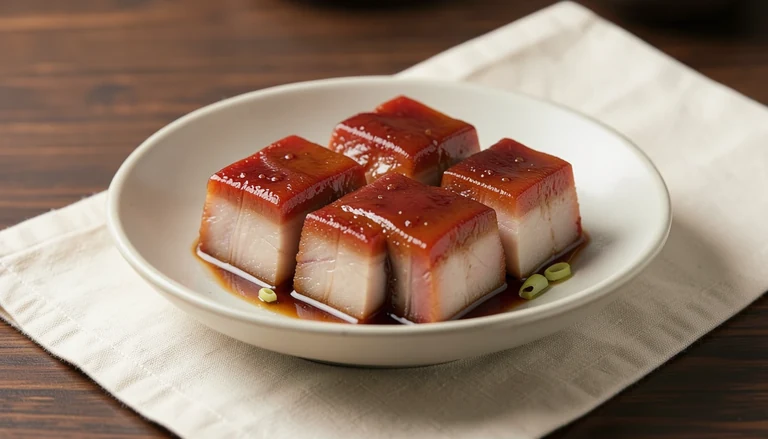
Red-braised pork is where the soy-and-sugar idea is easiest to taste. The Shanghai government calls hong shao rou (红烧肉) a soy-sauce braise of pork belly, and says the city’s version stresses dark soy for color and rock sugar for a balanced sweetness. It describes three textures: skin that is soft and slightly elastic, fat that melts smoothly, and lean meat that stays tender. The flavor, it says, is gently sweet and savory, with neither side dominating. The page records an informal picture of that balance, a soy bottle in one hand and a sugar jar in the other. (Shanghai municipal government — Red-braised pork (opens in a new tab), read )
The braise sits inside an older technique. Wikipedia’s red cooking article says the method likely originated in Jiangsu and is most strongly associated with the Jiangnan region, even though cooks use it throughout China. (Wikipedia — Red cooking (opens in a new tab), read ) It describes a reddish-brown color from soy, rock sugar and rice wine such as Shaoxing wine. (Wikipedia — Red cooking (opens in a new tab), read ) The Shanghai government’s home-style list includes Shaoxing wine, ginger, scallion, dark and light soy, rice vinegar and rock sugar, with about two hours of simmering before the sauce is reduced. (Shanghai municipal government — Red-braised pork (opens in a new tab), read ) Red braising is the glossary entry. The same government page notes slow-cooked meat in the sixth-century Qimin Yaoshu and says that text is not today’s pork belly. It treats Dongpo pork, linked to the Song-dynasty poet Su Dongpo and to Jiangnan cooking, as a later braise in the same family. (Shanghai municipal government — Red-braised pork (opens in a new tab), read )
Soup dumplings, shengjian, and a scallion pancake
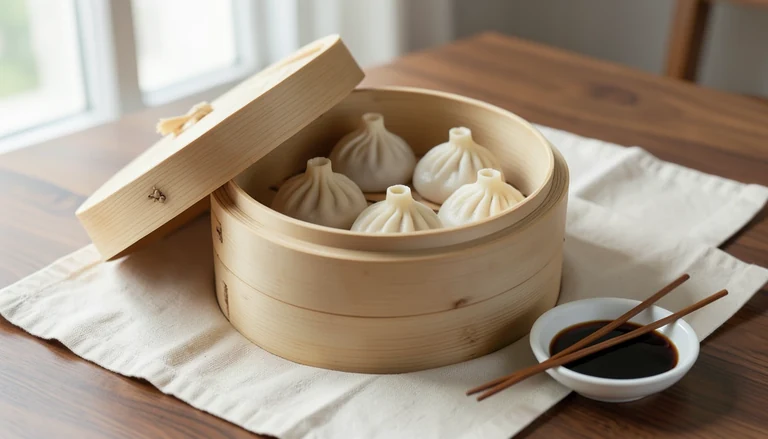
The Shanghai government traces xiaolongbao back to taixue mantou, a stuffed steamed bun of Northern Song Bianjing, now Kaifeng, and places the modern form in 1871. That year, it says, Huang Mingxian of the Ri Hua Xuan pastry shop in Nanxiang made the bun smaller and thinner-skinned and added meat jelly, so steaming released soup. Nanxiang is now in Shanghai’s Jiading district. A usual filling is minced pork with both lean meat and fat. The jelly melts in the steamer. Many people add a little Chinese black vinegar and shredded ginger. (Shanghai municipal government — Xiaolongbao (opens in a new tab), read ) The eating order on that page is specific: lift the dumpling by the pleated top onto a spoon, bite a small opening, sip the soup, then eat the rest. (Shanghai municipal government — Xiaolongbao (opens in a new tab), read ) Spring fillings can include malantou, a wild green. Summer fillings can be lighter, such as lotus root or vegetables. Autumn is when the page says crabs are at their peak, and crab-roe buns are the seasonal form. Winter menus sometimes add bamboo shoots. (Shanghai municipal government — Xiaolongbao (opens in a new tab), read )
Wikipedia’s xiaolongbao article says the bun is generally believed to have originated in Shanghai, and that the modern form evolved from the guantangbao of Kaifeng. It places xiaolongbao inside the wider tangbao family of soup-filled buns. In English the bun is often called a soup dumpling, a phrase the article says can also name other tangbao, including Kaifeng ones. Outside China, it says, the Nanxiang style associated with Shanghai is the most common. Suzhou and Wuxi versions are larger, sometimes twice as large, and sweeter. A Nanjing version is smaller, with a thinner skin and less meat. (Wikipedia — Xiaolongbao (opens in a new tab), read ) The dip notes on that article do not match the city page exactly. One passage says Zhenjiang vinegar with chili crisp. Another says Zhenjiang vinegar with ginger slivers. (Wikipedia — Xiaolongbao (opens in a new tab), read ) Chinkiang vinegar is that Zhenjiang black vinegar. The soup dumpling page and the dumpling field guide stay with broth inside the wrapper. Wontons versus dumplings is the comparison when “soup” means a bowl of broth around the parcels.
Shengjian (生煎) is a different dough. The Shanghai government describes it in English as pan-fried pork buns, says the snack began in neighboring Suzhou in the early 1910s, and says that by the 1920s it was a tea-house snack in Shanghai and a snack at neighborhood hot-water stations called laohuzao, or tiger stoves. The full name is shengjian mantou (生煎馒头). The page says mantou once covered every filled bun, that northern China later split plain mantou from filled baozi, and that Shanghai and the rest of Jiangnan kept the older usage. (Shanghai municipal government — Pan-fried pork buns (opens in a new tab), read )
That page then splits the bun in two. Hunshui uses semi-leavened dough, pleats facing down, and pork mixed with aspic made by simmering pork skin. The solid aspic melts into hot broth in the pan. Qingshui skips the added aspic, uses fully leavened dough and pleats facing up, so the bite is more like bread and the juice is the meat’s own. Orders are often counted in liang, and the page says one liang means four buns because one liang of flour traditionally made four. To eat one, set it on a spoon, open the top, sip, eat the pork, and only then dip the crisp base in vinegar. (Shanghai municipal government — Pan-fried pork buns (opens in a new tab), read )
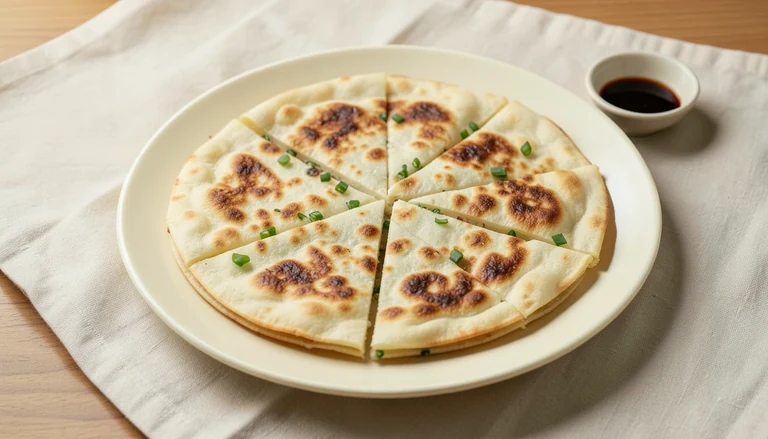
Scallion pancakes (葱油饼, cong you bing) are a flatbread, not a bun. The Shanghai government calls them a local snack with a golden crisp exterior, a strong scallion aroma and many layers. (Shanghai municipal government — Scallion pancakes (opens in a new tab), read ) China Sichuan Food’s guide says the same pancake is breakfast and street food across China, made from flour, oil and chopped scallions. A northern piece, on that guide, is thinner and chewier, uses less oil, and is sometimes about 30 centimeters across and sold by weight. A southern piece, with Shanghai as the example, is thicker, fried in more oil, with a crisper shell and a softer center. (China Sichuan Food — Scallion pancakes (opens in a new tab), read ) The breakfast guide is the page for a morning menu rather than a dinner order.
How a US menu uses the city name
Wikipedia’s American Chinese cuisine article says Shanghainese cooking is among the regional kitchens available in New York City, and that Bay Area restaurants specializing in Shanghainese traditions are widely available. Its Los Angeles section lists Shanghai, Nanjing and Wuxi among regional styles. It also says Joyce Chen introduced northern Chinese and Shanghainese dishes to Boston in the 1950s. Wikipedia’s sentence names Peking duck, moo shu pork, hot and sour soup and potstickers. (Wikipedia — American Chinese cuisine (opens in a new tab), read ) Peking duck and moo shu pork are northern Chinese dishes. That list is the article’s account of one introduction. It is not a definition of benbang cooking, and it is not a headcount of restaurants.
An English menu is easier to read one line at a time. “Soup dumpling” points at the tangbao family, and outside China the Nanxiang style tied to Shanghai is the form the xiaolongbao article calls the most common. (Wikipedia — Xiaolongbao (opens in a new tab), read ) A sweet soy braise of pork belly points at the Shanghai government’s hong shao rou. (Shanghai municipal government — Red-braised pork (opens in a new tab), read ) A line that only says “Shanghai” beside a mild vegetable has chosen neither plate. Ask whether the kitchen means benbang seasoning, a Jiangsu style, or a dish from somewhere else cooked in a room that happens to use the city name.
Those clues come from the pages cited here. They are not a survey of US menus. Non-spicy Chinese food is the guide when heat, rather than region, is the limit. A shared table is the guide when the braise is one plate among several.
Signature dishes
| Dish | Characters and romanization | What it is | Heat |
|---|---|---|---|
| Soup dumplings | 小笼包 · Xiǎo lóng bāo | Thin steamed buns from the Nanxiang line, with pork and a broth that starts as meat jelly. | Mild |
| Red-braised pork | 红烧肉 · Hóng shāo ròu | Pork belly braised with dark soy and rock sugar until the sauce is glossy and sweet-savory. | Mild |
| Scallion pancakes | 葱油饼 · Cōng yóu bǐng | Layered pan-fried flatbread. Shanghai pieces run thicker and oilier than a northern pancake. | Mild |
| Pan-fried pork buns | 生煎馒头 · Shēngjiān mántou | Shengjian. Hunshui buns hold melted pork-skin aspic. Qingshui buns leave the aspic out. | Mild |
Keep reading
Questions people ask
What is benbang cuisine?
Wikipedia’s Shanghai cuisine article uses benbang cai (本帮菜) for the narrow cooking that originated in Shanghai, as against a wider city table shaped by Jiangsu and Zhejiang, and as against Haipai cuisine, the style it ties to Western cooking. (Wikipedia — Shanghai cuisine (opens in a new tab), read ) The four-character phrase 浓油赤酱, a lot of oil and soy, with sugar often added, is the seasoning clue on that page. (Wikipedia — Shanghai cuisine (opens in a new tab), read )
Are soup dumplings the same thing as xiaolongbao?
In English, xiaolongbao are often called soup dumplings. Wikipedia says that English phrase can also cover other tangbao, including soup-filled buns from Kaifeng, so the translation is wider than one Shanghai shape. (Wikipedia — Xiaolongbao (opens in a new tab), read ) The Shanghai government reserves the modern Nanxiang form for the thinner 1871 bun whose jelly melts into broth. (Shanghai municipal government — Xiaolongbao (opens in a new tab), read ) Wontons versus dumplings separates that bun from a dumpling sitting in a bowl of soup.
Is Shanghai food the same as Jiangsu food?
No. Wikipedia’s Jiangsu article says Shanghai was formerly part of the province and that Shanghai cooking is sometimes classified inside Jiangsu cuisine, because the tables are similar. (Wikipedia — Jiangsu cuisine (opens in a new tab), read ) The Shanghai article still treats benbang cai as cooking that originated in the city, distinct from the Jiangsu and Zhejiang influence around it. (Wikipedia — Shanghai cuisine (opens in a new tab), read ) Ask which tradition a dish belongs to. The restaurant’s city does not answer that.
How do you eat a Shanghai soup dumpling?
The Shanghai government says to lift the dumpling by its pleated top onto a spoon, bite a small opening, sip the hot soup, and then eat the rest, often with a little black vinegar and shredded ginger. (Shanghai municipal government — Xiaolongbao (opens in a new tab), read ) Wikipedia’s xiaolongbao article also mentions Zhenjiang vinegar, sometimes with chili crisp and sometimes with ginger, so the dip is not one recipe. (Wikipedia — Xiaolongbao (opens in a new tab), read )
What is shengjian?
Shengjian (生煎), or shengjian mantou, is the pan-fried pork bun the Shanghai government traces to Suzhou in the early 1910s and to Shanghai tea houses by the 1920s. Hunshui buns are semi-leavened, pleated face down, and filled with pork plus pork-skin aspic that melts into broth. Qingshui buns are fully leavened, pleated face up, and skip that aspic. (Shanghai municipal government — Pan-fried pork buns (opens in a new tab), read ) One liang on that page means four buns.