Beijing, Shandong, and the wheat table
This page uses “northern” for Beijing cooking and for Shandong cooking, which Chinese sources call Lu cuisine (鲁菜). It is not a claim that the northeast, Shanxi and the northwest share one recipe. Wikipedia’s Shandong article counts Lu cuisine among the Eight Culinary Traditions and among the Four Great Traditions (四大菜系). (Wikipedia — Shandong cuisine (opens in a new tab), read ) UNESCO’s Chengdu page places Shandong in a set of four reference cuisines, beside Sichuan, Guangdong, and the cooking along the Yangtze and the Huaihe. (UNESCO Creative Cities — Chengdu (opens in a new tab), read )
The China Daily government portal, updated 31 May 2023, says Shandong cooks season with salt and soup stock so the ingredient stays fresh, and it lists four schools: Jiaodong, Jinan, Kongfu and herbal cuisine. Jiaodong, from Yantai and Qingdao, is deep-fried, braised, roasted or stewed, with soy sauce, shallots and garlic, and the portal calls the flavor light. Jinan, centered on Jinan, Tai’an and Dezhou, uses deep-frying, roasting, boiling and stir-frying, and the portal calls soups its representative dishes. Kongfu, cooking associated with Confucius’s descendants, was prepared for birthdays, weddings and funerals, and the portal says the taste stays light so the ingredient is not covered. Herbal cuisine, eaten as food therapy, is the form the portal dates to the Shang dynasty. (China Daily government portal — Shandong cuisine (opens in a new tab), read )
Wikipedia’s article does not use that four-school list. It names three styles: Jiaodong on the peninsula, where seafood is cooked light; Jinan, where soup is a feature; and Kongfu, around Jining and Qufu, where a dish may take three or four steps of braising, stir-frying, stewing, frying or grilling. (Wikipedia — Shandong cuisine (opens in a new tab), read ) Two public pages, two maps. This introduction does not fold them into one school.
Quick frying, a hung duck, and a wheat wrapper
Wikipedia names the Shandong techniques bao (爆), quick frying; liu (溜), quick frying with corn flour; pa (扒), stewing; kao (烤), roasting; and zhu (煮), boiling. (Wikipedia — Shandong cuisine (opens in a new tab), read ) The starch on the table is wheat more often than rice. The same article says people in Shandong tend to prefer steamed breads rather than rice. (Wikipedia — Shandong cuisine (opens in a new tab), read ) Wikipedia’s Beijing article gives a climate reason for the capital: local rice growing is limited by a relatively dry climate, so rice is a less usual accompaniment than in many other regions. (Wikipedia — Beijing cuisine (opens in a new tab), read ) A northern pancake is a different thickness from a Shanghai one. China Sichuan Food’s scallion-pancake guide describes the northern piece as thinner and chewier, made with less oil, sometimes about 30 centimeters across and sold by weight. (China Sichuan Food — Scallion pancakes (opens in a new tab), read ) The scallion pancake page keeps the Shanghai comparison next to that note.
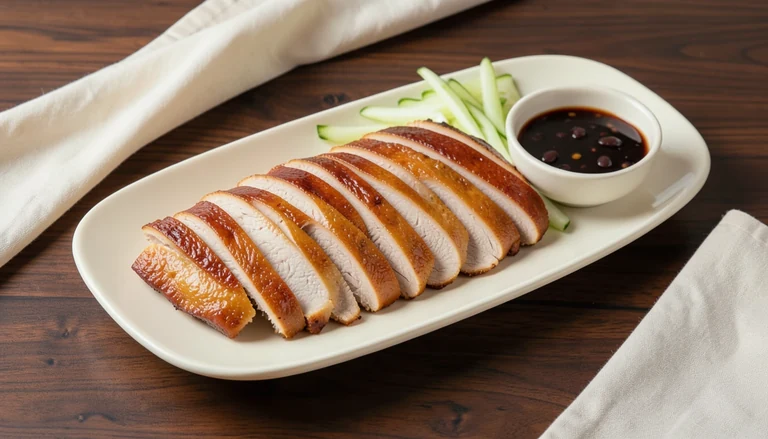
Beijing roast duck (北京烤鸭) is a roast, not a stir-fry. Wikipedia describes air pumped under the skin, a brief blanch, hanging to dry, and a glaze before the bird goes into the oven. It separates two ovens. A closed oven (焖炉, mènlú) is the method it associates with Bianyifang. A hung oven (挂炉, guàlú) is the method it says Qing imperial kitchens developed and Quanjude adopted: ducks hang over a hardwood fire of peach or pear, and the article gives 270 °C for 30 to 40 minutes. (Wikipedia — Peking duck (opens in a new tab), read ) Visit Beijing says the cook slices in front of the table, skin first, then meat with a thin layer still on the skin, and it calls the skin the essence of the dish. Accompaniments on that page are carrot and cucumber sticks, a steamed lotus-leaf pancake or a baked sesame cake, and one of three sauces: sweet bean sauce, mashed garlic with soy, or white sugar. (Beijing tourism — Beijing roast duck (opens in a new tab), read ) Wikipedia’s serving account is staged differently. Skin comes first, with sugar and sweet bean sauce. Meat follows with spring-onion pancakes (春饼, chūnbǐng), cucumber and spring onion. The carved frame can become a broth with cabbage and tofu, a stir-fry in sweet bean sauce, or a salt-and-pepper sauté. (Wikipedia — Peking duck (opens in a new tab), read ) Hoisin on this site is a separate condiment from the sweet bean sauce those two pages name. Ask which jar is on the table.
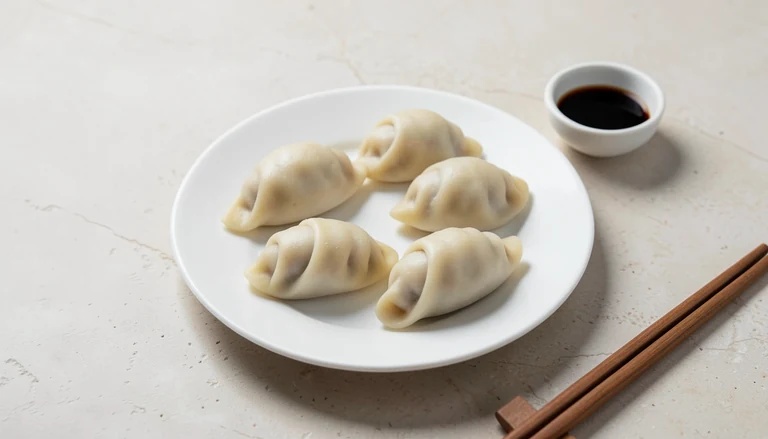
Jiaozi (饺子) are wheat wrappers with a meat or vegetable filling. Wikipedia lists boiled (水饺, shuǐjiǎo), steamed (蒸饺, zhēngjiǎo), pan-fried (煎饺, jiānjiǎo), deep-fried and baked forms, and it says a black-vinegar and soy dip is the traditional accompaniment. (Wikipedia — Jiaozi (opens in a new tab), read ) Visit Beijing describes a northern dip of vinegar and chili oil or chili paste, sometimes with soy sauce, and it lists pork, beef, shrimp and fish fillings, including pork with cabbage, pork with garlic chives, and garlic chives with scrambled eggs. Tianjin’s san xian filling on that page is pork, shrimp and chives. (Beijing tourism — Chinese dumplings (opens in a new tab), read ) The two dip notes do not match. Ask what is in the saucer.
Guotie (锅贴) are the pan-fried branch, and Wikipedia says the north treats them as their own dumpling: usually elongated, with the two ends often left open. In the south, the same article says, the word is a synonym for pan-fried jiaozi. In English, pan-fried jiaozi are often called potstickers, a word the article traces to Buwei Yang Chao’s How to Cook and Eat in Chinese, the 1949 revised edition. (Wikipedia — Jiaozi (opens in a new tab), read ) The guotie entry and the dumpling field guide stay with wrapper and cooking method. Wontons versus dumplings is the comparison when the menu says “dumpling” for a different shape.
Zhajiangmian (炸酱面) is the wheat noodle with a fried soybean-paste sauce. Wikipedia places the dish in Shandong and says the Shandong sauce is tianmianjiang, a version commonly viewed within China as the standard. The Beijing bowl, on the same page, fries yellow soybean paste with tianmianjiang, a large amount of scallion and diced pork rather than ground meat, then adds crunchy vegetables such as cucumber, radish, bean sprouts, celery and soybeans. Thick handmade noodles are the preference it records. (Wikipedia — Zhajiangmian (opens in a new tab), read ) Instant-boiled mutton (涮羊肉) is a different Beijing plate. The cuisine article’s table calls it a hot-pot variant whose base is boiling water, without extra spices, and whose meat is mutton. (Wikipedia — Beijing cuisine (opens in a new tab), read )
Dates that do not agree, left on the page
The government portal dates Lu cuisine to the late Shang and calls herbal cuisine the early form. (China Daily government portal — Shandong cuisine (opens in a new tab), read ) Wikipedia says the cuisine as it is known today was created in the Yuan dynasty, then spread through northern and northeastern China and influenced imperial cooking in Beijing and Tianjin. (Wikipedia — Shandong cuisine (opens in a new tab), read ) A Shang date and a Yuan date can both sit in the record. This page does not pick one as the founding year.
Beijing cooking, written 北京菜 and also 京菜, is the capital’s own table, and Wikipedia says Shandong has had the greatest influence on it. The same section names two other arrivals. Huaiyang cuisine came with officials and, when the Ming moved the capital from Nanjing in the 15th century, with an imperial kitchen the article describes as mainly Huaiyang. Chinese Islamic cooking became prominent when Beijing was the Yuan capital. Shandong cooks, by contrast, arrived in numbers in the Qing and, in that account, cooked for merchants and working people as well as for the court. (Wikipedia — Beijing cuisine (opens in a new tab), read ) Seasoning the article associates with Beijing itself is dark soy paste, sesame paste, sesame oil and scallions, with fermented tofu as a condiment, and with frying methods used often. Foods that began in the city, it says, are often snacks from small shops rather than banquet mains. (Wikipedia — Beijing cuisine (opens in a new tab), read )
The duck’s paper trail is narrower. Visit Beijing traces roasting to the Southern and Northern Dynasties (420–589), says Yuan emperors were served roast duck, and says the name was first written down in 1330, in a manual by Hu Sihui, an inspector of the imperial kitchen. (Beijing tourism — Beijing roast duck (opens in a new tab), read ) Wikipedia uses the same 1330 book, The Complete Recipes for Dishes and Beverages, for a dish then called shāo yāzi (烧鸭子), and it says the form later associated with the Peking name was fully developed in the Ming, when it was one of the main dishes on court menus. It dates Bianyifang, a duck restaurant near Qianmen, to 1416, and Quanjude to 1864. (Wikipedia — Peking duck (opens in a new tab), read ) The article also records an alternate name, Peking stuffed duck (北京填鸭), from force-feeding, and it cites a 2021 Beijing News report that at least 95 percent of ducks used in Beijing no longer needed that feeding. (Wikipedia — Peking duck (opens in a new tab), read )
Jiaozi have a legend and a later written note, and they are not the same sentence. Visit Beijing tells a story in which the physician Zhang Zhongjing, around 190 AD, wrapped mutton and herbs in dough for villagers with frostbitten ears. (Beijing tourism — Chinese dumplings (opens in a new tab), read ) Wikipedia calls an Eastern Han invention by Zhang Zhongjing the traditional account, then cites Yan Zhitui in the Northern Qi (550–577) on crescent-shaped jiaozi as ordinary food, and dumplings from Tang-dynasty tombs at Turfan. (Wikipedia — Jiaozi (opens in a new tab), read ) The legend is not the tomb find. Wikipedia also says the crescent shape later echoed the silver and gold ingots called yuanbao, which is why many families eat jiaozi at midnight on Chinese New Year’s Eve. (Wikipedia — Jiaozi (opens in a new tab), read )
Peking, moo shu, and a brown-sauce beef
English menus print both Peking and Beijing for 北京烤鸭. Visit Beijing uses Beijing roast duck. (Beijing tourism — Beijing roast duck (opens in a new tab), read ) Wikipedia’s article is titled Peking duck and says the dish is from Beijing. (Wikipedia — Peking duck (opens in a new tab), read ) The spelling has not chosen the oven. Wikipedia describes a separate United Kingdom plate, crispy aromatic duck (香酥鸭): the bird is marinated, steamed until tender, then deep-fried, and the article places that method in the latter half of the twentieth century. It also says some menus in Germany label that fried duck as Peking duck. (Wikipedia — Peking duck (opens in a new tab), read ) A line that only says “Peking duck” has not said whether the kitchen hung a glazed bird or fried a steamed one. Peking duck versus Cantonese roast duck separates this roast from Cantonese siu mei when both birds are offered.
Moo shu pork is a second translation problem. Wikipedia’s Beijing cuisine table lists 木须肉 (mùxūròu) and glosses it “wood shavings meat.” (Wikipedia — Beijing cuisine (opens in a new tab), read ) The American Chinese cuisine article says the original version uses ingredients such as wood-ear fungi and daylily buds, with thin flour pancakes, while a version in the United States often uses vegetables more familiar there and thicker pancakes. The article calls the dish quite popular in Chinese restaurants in the United States, and not as popular in China. (Wikipedia — American Chinese cuisine (opens in a new tab), read ) Wood shavings, wood ear and a thicker pancake are three different clues. Ask which plate the line means.
The same American article places Mongolian beef in its list of American Chinese dishes and describes fried beef with scallions or white onions in a spicy and often sweet brown sauce. (Wikipedia — American Chinese cuisine (opens in a new tab), read ) That sentence is not a Beijing recipe. Nearby, the article describes ginger fried beef (干炒牛肉丝) as beef in strings, battered, deep-fried, then fried again in a sweet sauce, and it calls that plate a variation of a northern Chinese dish. (Wikipedia — American Chinese cuisine (opens in a new tab), read ) A brown sweet sauce on beef is a question, not a region.
Where the article is specific about restaurants, it names places rather than a national count. It says restaurants specializing in northern Chinese traditions are widely available in the San Francisco Bay Area, in a list that also includes Cantonese, Sichuan, Hunan, Shanghainese, Taiwanese and Hong Kong cooking. (Wikipedia — American Chinese cuisine (opens in a new tab), read ) It credits Joyce Chen with bringing Peking duck, moo shu pork, hot and sour soup and potstickers to Boston in the 1950s, and it records her name for the dumplings, Peking Ravioli. (Wikipedia — American Chinese cuisine (opens in a new tab), read ) Those are the article’s reports about two metropolitan areas. They do not say what a particular kitchen is roasting this week. The takeout menu guide is the page for moo shu and the other English names. A shared table is the page when the duck is the center of the order and the rest of the meal has to sit beside it.
Signature dishes
| Dish | Characters and romanization | What it is | Heat |
|---|---|---|---|
| Peking duck | 北京烤鸭 · Běi jīng kǎo yā | Roast duck with crisp skin, pancakes and a sauce. Closed-oven and hung-oven accounts differ. | Mild |
| Jiaozi dumplings | 饺子 · Jiǎo zi | Wheat wrappers boiled, steamed or pan-fried. Northern dips in the cited pages do not match. | Mild |
| Zhajiangmian | 炸酱面 · Zhá jiàng miàn | Thick wheat noodles with fried soybean paste. Shandong and Beijing sauces are not the same mix. | Mild |
| Moo shu pork | 木须肉 · Mù xū ròu | “Wood shavings meat” on the Beijing table. US menus often change the vegetables and the pancake. | Mild |
| Instant-boiled mutton | 涮羊肉 · Shuàn yáng ròu | A Beijing hot-pot variant. The cuisine article describes plain boiling water and mutton. | Mild |
Keep reading
Questions people ask
Is northern Chinese food one cuisine?
No. This page is a starting map of Beijing cooking and of Shandong, or Lu, cooking. Wikipedia counts Lu cuisine among the Eight Culinary Traditions and the Four Great Traditions, and UNESCO’s Chengdu page names Shandong as one of four reference cuisines. (Wikipedia — Shandong cuisine (opens in a new tab), read ) (UNESCO Creative Cities — Chengdu (opens in a new tab), read ) The northeast and the northwest are not the same kitchens. The northwestern page is the map for Lanzhou noodles, Shaanxi bread and Xinjiang lamb.
How is Shandong cooking different from Beijing cooking?
The government portal seasons Shandong food with salt and soup stock and lists Jiaodong, Jinan, Kongfu and herbal schools. (China Daily government portal — Shandong cuisine (opens in a new tab), read ) Wikipedia’s Shandong article instead lists three styles and a set of techniques: quick frying, quick frying with corn flour, stewing, roasting and boiling. (Wikipedia — Shandong cuisine (opens in a new tab), read ) Wikipedia’s Beijing article names Shandong cooking as the greatest influence on the capital, and it also traces Huaiyang cooks to the Ming court and Islamic lamb and beef cooking to the Yuan. (Wikipedia — Beijing cuisine (opens in a new tab), read ) A menu that only says “northern” has not chosen among those.
What should you ask before ordering Peking duck?
Ask how the bird was roasted, what the pancake and sauce are, and whether one duck is a whole meal. Visit Beijing describes slicing at the table, sweet bean sauce or garlic-soy or sugar, and either a steamed pancake or a sesame cake. (Beijing tourism — Beijing roast duck (opens in a new tab), read ) Wikipedia separates a closed oven associated with Bianyifang from a hung oven associated with Quanjude, and it describes a British crispy aromatic duck, steamed and then deep-fried, that some German menus label as Peking duck. (Wikipedia — Peking duck (opens in a new tab), read ) The English spelling has not answered those questions.
Are potstickers the same as jiaozi?
They overlap, and the north splits them. Wikipedia says guotie are usually elongated, often left open at the ends, and treated in northern China as a separate dumpling, while southern kitchens use the word for pan-fried jiaozi. English “potsticker,” it says, comes from guotie by way of a 1949 cookbook. (Wikipedia — Jiaozi (opens in a new tab), read ) Boiled jiaozi are a different texture from that crisp-bottomed pan. The jiaozi page is the place for fillings.
Is moo shu on a US menu the Beijing dish?
The names meet, and the plates may not. Wikipedia’s Beijing table lists 木须肉 and translates it “wood shavings meat.” (Wikipedia — Beijing cuisine (opens in a new tab), read ) The American Chinese cuisine article says an original version uses wood-ear fungi, daylily buds and thin flour pancakes, and that a United States version often changes the vegetables and uses a thicker pancake. (Wikipedia — American Chinese cuisine (opens in a new tab), read ) Mongolian beef, on that same article, is a different American Chinese plate: fried beef with scallions or white onions in a spicy and often sweet brown sauce. (Wikipedia — American Chinese cuisine (opens in a new tab), read )