Five regions, not one menu heading
“Northwestern” on a US menu is a direction, not a recipe. A Beijing municipal government page dated 14 October 2024 describes the kitchens separately. Shaanxi cooking, it says, has southern, northern and Guanzhong styles, and the flavors it names are savory, sour, spicy and salty. The dishes it lists include roujiamo, lamb paomo and youpo mian, oil-sprinkled noodles. Gansu cooking, it says, is represented by Lanzhou-style food: beef and mutton roasted, boiled or stewed, with fewer ingredients, and usually salty, savory, sour and spicy. (Beijing municipal government — Northwest China (opens in a new tab), read )
The same page keeps going. Qinghai cooking mixes Han and Hui food and draws on pastoral traditions. Ningxia cooking gives a large place to Hui dishes beside Han ones, with beef and mutton as mainstays. Xinjiang cooking, it says, is halal, uses beef and mutton, and can be quick-fried, grilled, boiled, roasted, sauced, braised or steamed, with flavors that tend toward sour and spicy. (Beijing municipal government — Northwest China (opens in a new tab), read ) A single “northwest” heading has not said which of those tables the kitchen cooks.
Xi’an’s own English page, updated 18 January 2019, is a city list rather than a provincial system. It names biangbiang noodles, oil-sprinkled noodles and sliced noodles among the city’s wheat bowls, and it describes 牛羊肉泡馍 as crumbled flatbread in a beef and mutton stew. (Xi’an municipal government — Local food (opens in a new tab), read ) The Xi’an ordering guide is the practical page for that city. This primer does not turn the guide into a second copy.
A pulled strand, a belt, and a clay-oven bread
Lamian (拉面) means a noodle that is pulled. Wikipedia describes twisting, stretching and folding soft wheat dough, with the number of folds setting length and thickness. The earliest description it cites of that pulling method is the Songshi Yangsheng Bu, a dietary manual Song Xu wrote in 1504. In the Lanzhou style, the same article says, the pull is a straight, quick tug, and the noodle is sometimes slammed on the board. A Beijing style, by contrast, waves the dough and dusts it with more flour. (Wikipedia — Lamian (opens in a new tab), read ) The lamian entry is the definition to use. Knife-cut noodles are a different motion, shaved from a dough block, and the glossary places them in Shanxi. A shop that offers both has not made them one noodle.
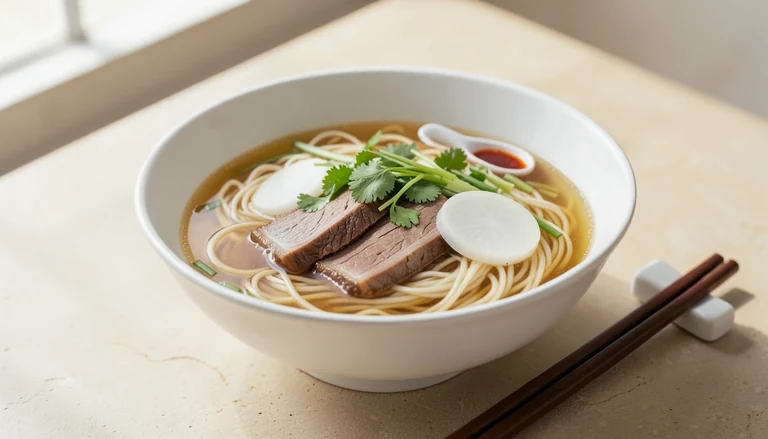
Lanzhou beef noodles (兰州牛肉面) are the soup bowl this site has a page for. Gansu tourism dates the dish to the reign of the Guangxu emperor (1875–1908) and lists five features: clear soup, white radish, red pepper, green caraway and yellow noodles. The noodles, it says, may be wide or thin. (Gansu tourism — Lanzhou beef noodles (opens in a new tab), read ) Global Times, in a 2011 report, writes the same standard as yī qīng, èr bái, sān lǜ, sì hóng, wǔ huáng: clear, white, green, red and yellow. A Gansu-born source in that article glosses the colors as a clear aromatic broth, thinly sliced white radish, cilantro and scallions, diced red pepper, and yellow noodles, and the article says the broth he describes is usually made with tender yak meat and beef leg bones, with chicken broth sometimes added. (Global Times — The art of noodling (opens in a new tab), read ) Caraway on the tourism page and cilantro on the newspaper page are not the same herb. Both wordings stay on the record.
The pull itself is counted in that Global Times account. Dough is drawn to about an arm’s length, looped, and slapped on the board so the strands stay even. Extra-thin noodles usually take ten rounds of looping and slapping. Medium noodles take six or seven. Width names in the article include máo xì, thin as a hair, plus thin, wide and very wide. (Global Times — The art of noodling (opens in a new tab), read ) Wikipedia adds a kitchen pattern around the noodle, not a broth rule: most lamian restaurants in China, it says, are owned by Hui families from the northwest and serve only halal food, so pork is absent. (Wikipedia — Lamian (opens in a new tab), read ) A clear bowl and a no-pork rule answer different questions. Ask both.
Biangbiang noodles are the wide Shaanxi strand, also written yóupō chěmiàn (油泼扯面), which Wikipedia glosses as oil-splashed hand-pulled noodles. The article describes them as belt-like, thick and long, and usually made by hand. It treats biáng as an onomatopoeia for dough hitting the board. The character used to write that sound is unusually complicated, and the article says it is not in the Kangxi dictionary, so the origin stories, including one about the Qin minister Li Si, stay unverified there. (Wikipedia — Biangbiang noodles (opens in a new tab), read ) The Beijing government page’s “youpo mian” and the Xi’an page’s biangbiang noodles are the two English labels. (Beijing municipal government — Northwest China (opens in a new tab), read ) (Xi’an municipal government — Local food (opens in a new tab), read ) Menus that cannot print the character often use pinyin.
Roujiamo (肉夹馍) is bread with a stew inside it, not a noodle. Wikipedia calls it a Shaanxi street food: pork is the usual meat, stewed for hours with spices, then chopped into baijimo (白吉馍), a yeasted wheat flatbread. An oven-baked baijimo is cooked in a clay oven; the article says many shops now cook the bread in a frying pan, and that the taste changes. In Muslim areas of Xi’an the meat is usually beef seasoned with cumin and pepper. In Gansu it is often lamb. (Wikipedia — Roujiamo (opens in a new tab), read ) The Xi’an government page uses the English comparison “Chinese hamburger” for marinated meat in baked baiji bread. (Xi’an municipal government — Local food (opens in a new tab), read ) That comparison is a translation. It does not date the snack, and this page does not add a founding dynasty on top of it. Paomo is the crumbled-bread bowl beside the sandwich. Xi’an writes 牛羊肉泡馍 and describes flatbread crumbled into a beef and mutton stew. (Xi’an municipal government — Local food (opens in a new tab), read ) The Beijing page’s English gloss for lamb paomo is “lamb soup with unleavened flat bread.” (Beijing municipal government — Northwest China (opens in a new tab), read ) Crumbled bread in a stew and unleavened bread in a lamb soup may be one family of dishes. The two pages do not print one recipe.
Xinjiang plates: a pull, a skewer, a big plate
Wikipedia’s Uyghur cuisine article, which also answers to the Xinjiang cuisine URL, says the food is predominantly halal because most Uyghur people are Muslim, and it names polo, laghman and nan among the dishes. Laghman (手拉面, shǒu lāmiàn) is boiled hand-pulled wheat noodles with a stir-fried topping, säy, usually mutton, onions, peppers and tomatoes. The article says the noodle was most likely derived from lamian. Polo (抓饭, zhuāfàn) is a pilaf: mutton or chicken, onions and sliced carrots fried, then rice and water added and the pot steamed. Raisins or dried apricots may go in. The article says the dish is traditionally eaten with the hands. Kawap are lamb or beef skewers seasoned with salt, black pepper, chili powder and cumin, eaten off the stick. (Wikipedia — Uyghur cuisine (opens in a new tab), read ) The Beijing government page’s “halal” and “sour and spicy” are the municipal wording for Xinjiang cooking as a whole. (Beijing municipal government — Northwest China (opens in a new tab), read ) A cumin skewer and a pepper-topped laghman are two plates inside that wording.
Big plate chicken (大盘鸡, dàpánjī) has a dated origin story in that article, and it is a fusion account rather than an ancient one. The dish, also called chong texse toxu qorumis in Uyghur, is a spicy, hot chicken stew on a large plate. After the chicken is eaten, flat hand-pulled noodles go into the sauce that remains. The article says the plate gained popularity in the mid to late 1990s and was created in Shawan, in northern Xinjiang, by a migrant from Sichuan who combined hot chili peppers with chicken and potatoes while trying to reproduce a Sichuan taste. (Wikipedia — Uyghur cuisine (opens in a new tab), read ) A Sichuan chili and a Xinjiang table can meet in one pan. The region name has not said whether the bowl in front of you is that stew, a clear Lanzhou soup, or a cumin skewer.
What a hand-pulled sign can mean
Wikipedia’s lamian article is specific about a few blocks and silent about a national map. In Manhattan and in Sunset Park, it says lamian restaurants are a common sight, most of them run by people from Fuzhou. Some of those shops offer knife-cut noodles, and most feature only the hand-pulled kind. In Manhattan it places most of them east of Bowery; in Sunset Park, along 8th Avenue. (Wikipedia — Lamian (opens in a new tab), read ) A hand-pulled sign in those neighborhoods is the article’s report. It is not a promise that the broth will match the five-color standard Global Times describes, and it is not a promise that the owners are Hui families from Gansu. (Global Times — The art of noodling (opens in a new tab), read ) (Wikipedia — Lamian (opens in a new tab), read ) The same article says Japanese ramen borrowed the name lāmiàn and that the Japanese dish did not derive from the Chinese noodle. (Wikipedia — Lamian (opens in a new tab), read ) Ramen on a menu is a different bowl.
Read the protein before you read the region. A pork roujiamo, a halal Lanzhou beef bowl and a cumin lamb skewer can share a wheat belt and still be three kitchens. (Wikipedia — Roujiamo (opens in a new tab), read ) (Wikipedia — Lamian (opens in a new tab), read ) (Wikipedia — Uyghur cuisine (opens in a new tab), read ) If the menu says northwest, Lanzhou, Xi’an, Xinjiang or Uyghur, ask which word the kitchen means, whether pork is cooked in the same pots, and whether the noodle is pulled, oil-splashed or sitting under a chicken stew. The noodle guide separates widths and broths. Regional flavors treats the eight-cuisine list as a start and then points past it. Beijing and Shandong are the wheat tables to the east of this map, not a second name for it.
Signature dishes
| Dish | Characters and romanization | What it is | Heat |
|---|---|---|---|
| Lanzhou beef noodles | 兰州牛肉面 · Lán zhōu niú ròu miàn | Clear beef broth, radish, chili and a hand-pulled noodle. Herb wording differs by source. | Medium |
| Biangbiang noodles | 油泼扯面 · Yóu pō chě miàn | Belt-wide Shaanxi noodles, also called biangbiang. The biáng character is not in the Kangxi dictionary. | Varies |
| Roujiamo | 肉夹馍 · Ròu jiā mó | Stewed meat in a baked wheat flatbread. Pork, cumin beef and lamb versions are all described. | Varies |
| Paomo | 牛羊肉泡馍 · Niú yáng ròu pào mó | Bread crumbled into a beef and mutton stew. Another English gloss calls it lamb soup with flatbread. | Varies |
| Big plate chicken | 大盘鸡 · Dà pán jī | A spicy chicken-and-potato stew. Hand-pulled noodles go into the sauce after the chicken. | Hot |
Keep reading
Questions people ask
What are the five colors in a Lanzhou beef noodle bowl?
Gansu tourism lists clear soup, white radish, red pepper, green caraway and yellow noodles, and it dates the dish to the Guangxu reign, 1875 to 1908. (Gansu tourism — Lanzhou beef noodles (opens in a new tab), read ) Global Times writes the same sequence as clear, white, green, red and yellow, and a Gansu-born source in that article names cilantro and scallions for the green, not caraway. (Global Times — The art of noodling (opens in a new tab), read ) The two pages agree on a clear broth and a yellow noodle. They do not agree on the herb.
How is biangbiang different from Lanzhou lamian?
Lanzhou lamian is a soup noodle pulled in quick tugs, and Wikipedia contrasts that tug with a more delicate Beijing pull. (Wikipedia — Lamian (opens in a new tab), read ) Biangbiang, or youpo chemian, is a Shaanxi belt noodle, thick and long, usually handmade, with biáng treated as the sound of dough hitting the board. (Wikipedia — Biangbiang noodles (opens in a new tab), read ) Width is the visible difference. A menu that says only “hand-pulled” has not chosen the belt or the soup.
Does roujiamo contain pork?
Often, and not always. Wikipedia says the usual Shaanxi filling is pork stewed for hours and stuffed into baijimo. In Muslim areas of Xi’an the meat is usually beef with cumin and pepper, and in Gansu it is often lamb. (Wikipedia — Roujiamo (opens in a new tab), read ) The Xi’an government page describes marinated meat in baked baiji bread and calls the snack a Chinese hamburger. (Xi’an municipal government — Local food (opens in a new tab), read ) Ask which meat is in the bread. The English comparison has not said.
What is big plate chicken?
Wikipedia’s Uyghur cuisine article describes dàpánjī as a spicy, hot chicken stew served on a large plate, with flat hand-pulled noodles added to the remaining sauce once the chicken is eaten. It says the dish was created in Shawan, northern Xinjiang, in the mid to late 1990s, by a migrant from Sichuan who combined chili peppers, chicken and potatoes. (Wikipedia — Uyghur cuisine (opens in a new tab), read ) The chili in that account is part of the stew. It is not the clear Lanzhou broth.
Why might a hand-pulled noodle shop serve no pork?
Wikipedia says most lamian restaurants in China are owned by Hui families from the northwest and serve only halal food, which means no pork. (Wikipedia — Lamian (opens in a new tab), read ) The Beijing government page separately calls Xinjiang cooking halal. (Beijing municipal government — Northwest China (opens in a new tab), read ) A Fuzhou-run hand-pulled shop, which the lamian article describes in parts of New York, is not that pattern. (Wikipedia — Lamian (opens in a new tab), read ) Ask whether the kitchen cooks pork, instead of guessing from the noodle.