Lanzhou beef noodles
兰州牛肉面
Lán zhōu niú ròu miàn
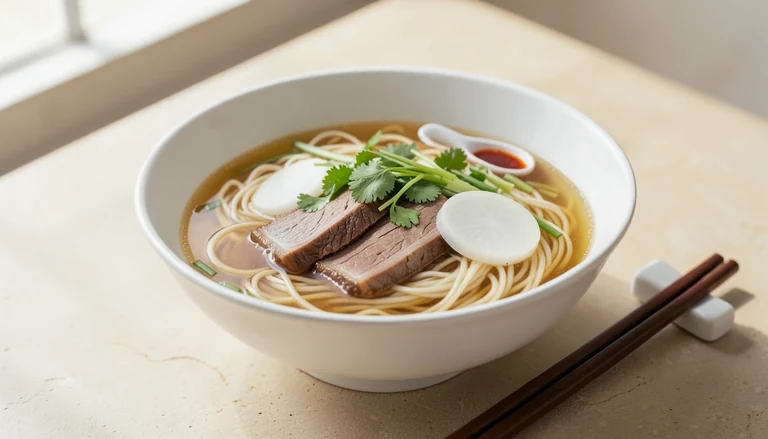
A clear beef broth with pulled noodles, radish, greens and a bright touch of chili oil.
| Fact | Detail |
|---|---|
| Heat | Medium |
| Main protein | Beef |
| Region | Northwestern |
| Common menu names | Lanzhou beef noodles, Lanzhou beef noodle soup |
Lanzhou niu rou mian, and the wider beef noodle bowl
Lanzhou beef noodles are 兰州牛肉面 in simplified characters and 蘭州牛肉麵 in traditional characters. Wikipedia gives the pinyin lanzhou niúròu miàn. The general dish is 牛肉面 or 牛肉麵, niúròu miàn, literally beef noodles. (Wikipedia — Lanzhou beef noodles (opens in a new tab), read ) (Wikipedia — Beef noodle soup (opens in a new tab), read )
The Lanzhou article calls the dish a beef noodle soup from Lanzhou in Gansu and ties it to Hui Muslim cooking. It dates a Hui variation of beef noodle soup to the Tang dynasty and attributes the modern form to Ma Baozi, a Hui Muslim from Lanzhou who began selling it in 1915. It says the skill was added to China’s national intangible cultural heritage list in 2021. (Wikipedia — Lanzhou beef noodles (opens in a new tab), read )
The wider article treats beef noodle soup as a family: stewed or braised beef, beef broth, vegetables and noodles. It names Lanzhou niuroumian as an early example and says it was created by Hui people of northwest China in the Tang dynasty. It also names the red-braised Taiwanese bowl, pho from Vietnam and other soups under the same English phrase. (Wikipedia — Beef noodle soup (opens in a new tab), read )
The Lanzhou name is used loosely. Wikipedia says the “Lanzhou Lamian” found outside Lanzhou is not the same dish, but a halal-style lamian from Hualong in Qinghai marketed under the Lanzhou name. (Wikipedia — Lanzhou beef noodles (opens in a new tab), read ) A sign is therefore a clue about the kitchen, not a guarantee about the broth.
Clear broth, no soy sauce, five colors
Wikipedia describes the bowl as hand-pulled lamian in a clear consommé stewed from beef. It says the meat is often qingzhen, halal, and that the broth contains no soy sauce, which leaves a lighter taste seasoned with salt and herbs. The page also calls it qingdun beef noodles, 清炖牛肉面, clear-stewed beef noodles. (Wikipedia — Lanzhou beef noodles (opens in a new tab), read )
The same page names radish and a specially cooked chili oil as indispensable, and gives the local standard as one clear, two white, three red, four green, five yellow: 一清、二白、三红、四绿、五黄. Clear soup; crystal-white radish; bright red chili oil; green cilantro and garlic shoots; smooth, bright yellow noodles. (Wikipedia — Lanzhou beef noodles (opens in a new tab), read )
Global Times reported the same standard in 2011 as yi qing, er bai, san lv, si hong, wu huang. A Gansu-born source in the article glossed the colors as a clear aromatic broth, thinly sliced white radish, cilantro and scallions, diced red pepper and yellow noodles. The article says the clear broth is usually made with tender yak meat and beef leg bones, sometimes with chicken broth added. (Global Times — The art of noodling (opens in a new tab), read )
The noodle is pulled to order. Wikipedia lists eight shapes: thinnest 毛细, thinner 细面, thin 三细, thick 二细, thicker 粗面, prism 韭叶, wide 宽面 and wider 大宽. It says the thinnest is about two-thirds the thickness of spaghetti, the thick and thicker are round, and the prism and wide shapes are flat. (Wikipedia — Lanzhou beef noodles (opens in a new tab), read ) Global Times adds that a bowl goes from order to table in under 10 minutes, with the dough pulled to about an arm’s length, looped and slapped; extra-thin noodles take about ten rounds and medium noodles six or seven. (Global Times — The art of noodling (opens in a new tab), read )
The home recipe is a different project. The Woks of Life roasts beef bones, blanches beef shank and chicken, then simmers them with a spice packet that includes star anise, cloves, cinnamon, bay leaves, sand ginger, fennel, cumin, Sichuan and white peppercorns, licorice, dried orange peel and black cardamom. It adds sliced Chinese radish for the last hour and makes a chili oil with star anise, cinnamon and Sichuan peppercorns. It uses fresh or dried white noodles rather than pulling them. (The Woks of Life — Lanzhou beef noodle soup (opens in a new tab), read )
Red-braised Taiwan, and bowls that share the name
Taiwanese beef noodle soup is the red-braised bowl, 红烧牛肉面. Wikipedia says it was first created by Sichuanese Kuomintang veterans and is sometimes called Sichuan beef noodle soup in Taiwan, even though Sichuan has its own versions. The beef is often stewed with the broth for a long time, and some vendors cook the stock for more than 24 hours. It is served with suan cai, green onion and sometimes other vegetables, with cold side dishes such as braised dried tofu, seaweed or pork intestine. (Wikipedia — Beef noodle soup (opens in a new tab), read )
The difference is visible before the first sip. The Lanzhou bowl is clear and does not use soy sauce; the Taiwanese bowl is red-braised, and Wikipedia’s red cooking article says soy sauce, rice wine and rock sugar are the base of that braise. (Wikipedia — Lanzhou beef noodles (opens in a new tab), read ) (Wikipedia — Beef noodle soup (opens in a new tab), read ) (Wikipedia — Red cooking (opens in a new tab), read ) A menu that says beef noodle soup has not chosen between them.
Singapore has a Teochew version. The beef noodle article describes a soup with a broth brewed from beef bones, flat kway teow noodles, sliced beef and beef innards. It says Bovril was traditionally added to the stock, and extras included beef tongue, tripe and gu piang. (Wikipedia — Beef noodle soup (opens in a new tab), read )
New Orleans has yaka mein. The same article describes stewed beef, spaghetti, hard-boiled egg and chopped green onion, seasoned with Cajun seasoning, chili powder or Old Bay. (Wikipedia — Beef noodle soup (opens in a new tab), read ) Vietnam’s pho is another beef noodle soup in the same article, built on rice noodles and herbs. (Wikipedia — Beef noodle soup (opens in a new tab), read ) Those are three bowls under one English name, and none of them is the Lanzhou standard.
How to order a bowl
Choose the width if the shop offers it. Wikipedia’s eight names are the ones to look for, and Global Times lists mao xi, xi, xiao kuan and da kuan on a Shanghai menu. (Wikipedia — Lanzhou beef noodles (opens in a new tab), read ) (Global Times — The art of noodling (opens in a new tab), read ) Thin and wide noodles take the same broth differently, so the choice is worth making.
Ask for chili oil on the side if you want control. Wikipedia calls the red oil indispensable and Global Times describes diced red pepper as the red element. (Wikipedia — Lanzhou beef noodles (opens in a new tab), read ) (Global Times — The art of noodling (opens in a new tab), read ) The heat is a finishing layer, not the base of the broth.
Ask about meat and halal practice. Wikipedia says halal restaurants use local Southern Yellow cattle prepared by a halal butcher, and that most lamian restaurants in China are owned by Hui families and serve only halal food, so pork is absent. (Wikipedia — Lanzhou beef noodles (opens in a new tab), read ) (Wikipedia — Lamian (opens in a new tab), read ) A shop that also cooks pork is a different kitchen.
The English name on a US menu may be Lanzhou Beef Noodle Soup, Beef Noodle Soup or Taiwan Beef Noodle Soup. The Frisco guide includes all three wordings on checked menus, and the Los Angeles guide includes House Special Beef Noodle Soup. Those are menu names, not a ranking. Northwestern cooking is the regional page, the noodle guide separates pulled, knife-cut and rice noodles, and the Xi’an ordering guide is the wheat-noodle meal nearby. Regional flavors is the wider map.
Regional versions
- Lanzhou clear broth. Hand-pulled lamian in a clear beef consommé, with white radish, red chili oil, green cilantro and scallion, and yellow noodles. The meat is often qingzhen, halal, and the broth contains no soy sauce. (Wikipedia — Lanzhou beef noodles (opens in a new tab), read ) Global Times gives the same five-color standard and says the broth is usually made with yak meat and beef leg bones. (Global Times — The art of noodling (opens in a new tab), read )
- Taiwanese red-braised. The red-braised bowl, 红烧牛肉面, which Wikipedia says was first created by Sichuanese Kuomintang veterans and is sometimes called Sichuan beef noodle soup in Taiwan. The beef is often stewed with the broth for a long time, and the bowl is served with suan cai and green onion. (Wikipedia — Beef noodle soup (opens in a new tab), read )
- Singapore Teochew. A Teochew beef noodle soup with a broth brewed from beef bones, flat kway teow noodles, sliced beef and beef innards. The article says Bovril was traditionally added to the stock, and extras included beef tongue, tripe and gu piang. (Wikipedia — Beef noodle soup (opens in a new tab), read )
- New Orleans yaka mein. A Chinese-restaurant bowl in New Orleans: stewed beef, spaghetti, hard-boiled egg and chopped green onion, seasoned with Cajun seasoning, chili powder or Old Bay. (Wikipedia — Beef noodle soup (opens in a new tab), read )
Questions people ask
What are the five colors in a Lanzhou beef noodle bowl?
The local standard is one clear, two white, three red, four green, five yellow: 一清、二白、三红、四绿、五黄. Wikipedia glosses that as clear soup, crystal-white radish, bright red chili oil, green cilantro and garlic shoots, and smooth bright yellow noodles. (Wikipedia — Lanzhou beef noodles (opens in a new tab), read ) Global Times gives the same sequence as clear, white, green, red and yellow and says a Gansu-born source named cilantro and scallions for the green. (Global Times — The art of noodling (opens in a new tab), read ) The pages agree on the clear broth and the yellow noodle; they do not agree on the herb.
Which noodle width should I order?
Wikipedia lists eight Lanzhou shapes: thinnest 毛细, thinner 细面, thin 三细, thick 二细, thicker 粗面, prism 韭叶, wide 宽面 and wider 大宽. It says the thinnest is about two-thirds the thickness of spaghetti, the thick and thicker are round, and the prism and wide shapes are flat. (Wikipedia — Lanzhou beef noodles (opens in a new tab), read ) Global Times names mao xi, xi, xiao kuan and da kuan and says extra-thin noodles take about ten rounds of pulling and slapping, while medium noodles take six or seven. (Global Times — The art of noodling (opens in a new tab), read ) Thin and wide noodles carry the same broth differently, so the choice is worth making.
Is Lanzhou beef noodle soup spicy?
The red in the bowl is chili oil, and Wikipedia calls radish and a specially cooked spicy oil indispensable partners to the dish. (Wikipedia — Lanzhou beef noodles (opens in a new tab), read ) Global Times describes diced red pepper as the red element in the five-color standard. (Global Times — The art of noodling (opens in a new tab), read ) The Woks of Life finishes its home bowl with a spoonful of hot chili oil. (The Woks of Life — Lanzhou beef noodle soup (opens in a new tab), read ) Ask for the oil on the side if you want to taste the clear broth first.
Is Lanzhou lamian outside Lanzhou the same dish?
Not according to Wikipedia. The Lanzhou article says the “Lanzhou Lamian” commonly found outside Lanzhou is not the same dish, but a halal-style lamian from Hualong in Qinghai marketed under the Lanzhou name. (Wikipedia — Lanzhou beef noodles (opens in a new tab), read ) The same page says Lanzhou beef noodles are associated with Hui Muslim cooking, and Wikipedia’s lamian article says most lamian restaurants in China are owned by Hui families and serve only halal food. (Wikipedia — Lanzhou beef noodles (opens in a new tab), read ) (Wikipedia — Lamian (opens in a new tab), read ) The sign tells you which name is being used, not which kitchen is behind it.
How is it different from Taiwanese beef noodle soup?
The Lanzhou bowl is clear and does not use soy sauce, with hand-pulled noodles, radish and chili oil. (Wikipedia — Lanzhou beef noodles (opens in a new tab), read ) The Taiwanese bowl is red-braised, 红烧牛肉面, which Wikipedia says was first created by Sichuanese Kuomintang veterans; the beef is often stewed with the broth for a long time and served with suan cai and green onion. (Wikipedia — Beef noodle soup (opens in a new tab), read ) A menu that says beef noodle soup has not chosen between the two.
Keep reading
Last reviewed
Where to eat lanzhou beef noodles
From each restaurant’s checked menu; call ahead — menus change.
Chinese food in Nashville
- Noodle EssenceLanzhou Beef Noodle Soup · Edmondson Pike at Old Hickory Boulevard
Chinese food in Albuquerque
- Tasty Noodles and DumplingsB1. Lan Zhou Beef Noodle Soup 兰州牛肉面 · San Pedro Drive NE
Chinese food in Frisco
- Kitchen Master (Frisco)Beef Noodle Soup · Preston Road
- Dumpling HouseBeef Noodle Soup · Preston Road
- 88 Baobao (Frisco)Taiwan Beef Noodle Soup · Eldorado Parkway
- Noodle One (Halal)Signature Beef Noodle Soup · Preston Road
Chinese food in Los Angeles
- Northern CafeHouse Special Beef Noodle Soup · Colima Rd
Sources & further reading
Background and preparation references. Our descriptions are editorial summaries, not restaurant reviews.
- Wikipedia — Lanzhou beef noodles (opens in a new tab) ↗ read
- Wikipedia — Beef noodle soup (opens in a new tab) ↗ read
- The Woks of Life — Lanzhou beef noodle soup (opens in a new tab) ↗ read
- Global Times — The art of noodling (opens in a new tab) ↗ read
- Wikipedia — Lamian (opens in a new tab) ↗ read
- Wikipedia — Red cooking (opens in a new tab) ↗ read