Yangzhou fried rice
扬州炒饭
Yáng zhōu chǎo fàn
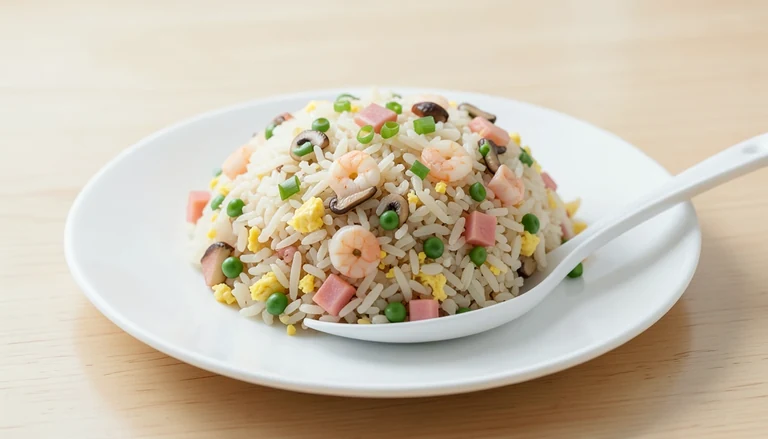
Pale, separate grains of fried rice with egg, shrimp and diced ham or roast pork, spelled Yang Chow on many menus.
Get to know the dish
Yangzhou’s government portal traces Yangzhou fried rice to the Sui dynasty and lists versions with eggs, with shrimp and eggs, and with ham and eggs. Its origin is disputed. VICE reports the legend that the Sui emperor Yang introduced it to Yangzhou, alongside a claim that it arose in Guangzhou during the Qing dynasty, and Made With Lau mentions both a sailors’ story and the Guangzhou claim. In 2002 the Yangzhou Cuisine Association published a rubric naming sea cucumber, chicken, ham, scallops, shrimp, mushrooms, bamboo shoots and green peas, in red, green, yellow and white, though VICE found the name used as a loose, interpretive label in Yangzhou itself.
What to look for
Separate grains, pale rather than soy-brown, with bright specks of egg, shrimp, meat and green. Visit Beijing’s Jiangsu guide says the dish should be pearly white with colourful specks, each grain coated in a simple seasoning of salt and pepper.
Every kitchen has its version
Cantonese kitchens changed the dish as they carried it abroad. Gourmet Traveller describes the Yeungchow fried rice Cantonese cooks introduced to the world as fresh prawns, char siu, spring onions and sometimes peas, and The Woks of Life’s Young Chow version adds ham, Chinese roast pork and crisp lettuce. Dim Sum Cantonese lists Chinese sausage as an alternative to barbecued pork.
Regional versions
- Yangzhou 2002 rubric. VICE reports a Yangzhou Cuisine Association rubric of sea cucumber, chicken, ham, scallops, shrimp, mushrooms, bamboo shoots and green peas.
- Everyday Yangzhou versions. Yangzhou’s government portal lists versions with eggs, with shrimp and eggs, and with ham and eggs.
- Cantonese Yeung Chow. Gourmet Traveller describes prawns, char siu, spring onions and sometimes peas; Dim Sum Cantonese adds Chinese sausage as an alternative to barbecued pork.
- Cantonese-American Young Chow. The Woks of Life uses ham and Chinese roast pork with shrimp and egg, and calls lettuce a signature ingredient.
Questions people ask
Are Yang Chow, Young Chow and Yangzhou fried rice the same dish?
Yes. The Woks of Life explains that early Chinese restaurant owners spelled the name through their own dialect, which produced Young Chow; Gourmet Traveller gives Yeungchow as the Cantonese pronunciation of Yangzhou.
Is Yangzhou fried rice really from Yangzhou?
It is disputed. Yangzhou’s portal dates it to the Sui dynasty, while VICE and Made With Lau report a claim that it began in Guangzhou. Treat the origin as contested and the name as a style.
How is it different from other fried rice?
Dim Sum Cantonese says it is distinguished by including multiple meats, where most Chinese fried dishes feature a single protein. Visit Beijing’s Jiangsu guide adds that it should look pearly white rather than soy-dark.
What allergens should I ask about?
Shrimp and egg appear in most versions described by Yangzhou’s portal, Gourmet Traveller and Dim Sum Cantonese, with ham, char siu or sausage for pork. The 2002 Yangzhou rubric also includes scallops and sea cucumber.
Last reviewed
Sources & further reading
Background and preparation references. Our descriptions are editorial summaries, not restaurant reviews.
- Yangzhou government portal (China Daily) — Yangzhou fried rice (opens in a new tab) ↗
- VICE — The highs and lows of China’s fried rice capital (opens in a new tab) ↗
- Made With Lau — Yangzhou fried rice (opens in a new tab) ↗
- The Woks of Life — Young Chow fried rice (opens in a new tab) ↗
- Gourmet Traveller — Yangzhou fried rice (opens in a new tab) ↗
- Dim Sum Cantonese — Yangzhou fried rice (opens in a new tab) ↗
- Visit Beijing — Jiangsu cuisine (opens in a new tab) ↗