Oyster omelette
海蛎煎
Hǎi lì jiān
Small oysters fried with egg, garlic shoots and sweet potato starch until crisp at the edges and chewy inside.
Get to know the dish
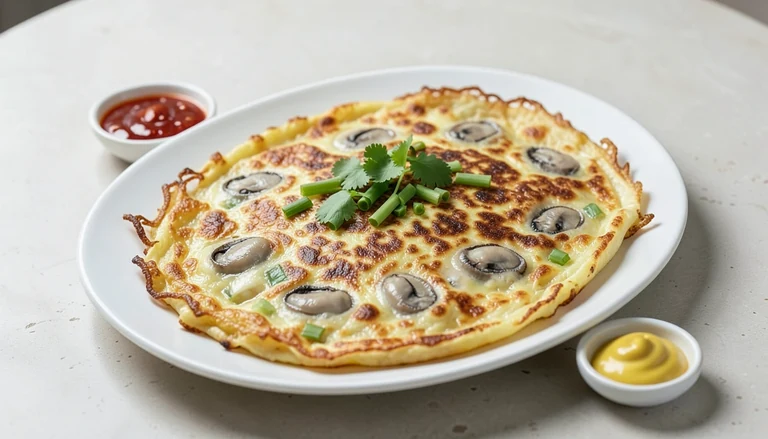
In Xiamen the oyster omelette is everyday food. The Xiamen city government describes small oysters mixed with garlic sprouts, Chinese chives and sweet potato flour, spread in hot oil with egg and fried on both sides, topped with pepper and coriander and dipped in mustard and chili sauce. China Daily’s government portal adds that local residents like it with porridge. Taiwanese Hokkien speakers call it o-a-tsian, according to the Taipei Times, and the Taiwan Tourism Administration says it is available at just about every night market in Taiwan. Goldthread notes a popular story crediting General Koxinga with inventing it for his troops in 1661, and calls that story more myth than reality.
What to look for
Crisp, browned edges around a softer center, with glossy, slightly chewy patches from the starch. Tiny Urban Kitchen credits sweet potato starch with the gelatinous, slightly chewy texture Taiwanese cooks call QQ.
Every kitchen has its version
Starch, greens and sauce change by place. The Taipei Times describes oysters, eggs and vegetables fried and covered with a sweet potato starch batter, then a sweet and spicy sauce, while the Taiwan Tourism Administration names potato starch and tapioca. Omnivore’s Cookbook says the Cantonese hao lao is thinner and crispier than the Taiwanese version.
Regional versions
- Xiamen style. Garlic sprouts, Chinese chives and sweet potato flour, fried on both sides and dipped in mustard and chili sauce, per the Xiamen city government.
- Taiwanese night-market style. Oysters, eggs and leafy vegetables fried over a high flame and finished with a sweet and sour sauce, per the Taiwan Tourism Administration.
- Cantonese hao lao. Omnivore’s Cookbook describes a thinner, crispier omelette than the Taiwanese version, which uses more starch for chew.
Questions people ask
How is a Fujian oyster omelette different from the Taiwanese one?
The Xiamen city government describes garlic sprouts, chives and sweet potato flour fried on both sides, with mustard and chili sauce on the side. Taiwanese versions add leafy greens and a sweet sauce, according to the Taiwan Tourism Administration and the Taipei Times.
Why is an oyster omelette gooey or chewy?
Starch. Tiny Urban Kitchen says sweet potato starch gives the gelatinous, slightly chewy texture Taiwanese cooks call QQ. The Taiwan Tourism Administration names potato starch and tapioca instead.
What is the red sauce?
On Taiwanese plates it is a sweet and spicy sauce; the Taipei Times names ketchup, miso and chili bean sauce. Xiamen-style plates usually come with mustard and chili sauce for dipping instead.
Is an oyster pancake the same thing?
Usually. English menus use oyster omelet, oyster omelette and oyster pancake for this family of dishes, and Goldthread calls the Xiamen version oyster pancakes. Ask whether the kitchen serves it Xiamen-style or Taiwanese-style.
Last reviewed
Where to eat oyster omelette
From each restaurant’s checked menu; call ahead — menus change.
Chinese food in Irvine
- Class 302 Cafeoyster omelet · Jamboree Road, ZIP 92602
Chinese food in New York
- Q Town Asian CuisineOyster Pancake · Broadway at Whitney Avenue, Elmhurst
Sources & further reading
Background and preparation references. Our descriptions are editorial summaries, not restaurant reviews.
- Xiamen municipal government — Oyster omelet (opens in a new tab) ↗
- China Daily government portal — Xiamen delicacies: oyster omelet (opens in a new tab) ↗
- Taiwan Tourism Administration — Taiwan snacks (opens in a new tab) ↗
- Taipei Times — The story of oyster omelet (opens in a new tab) ↗
- Tiny Urban Kitchen — Taiwanese oyster omelet (opens in a new tab) ↗
- Goldthread — Xiamen oyster pancakes (opens in a new tab) ↗
- Omnivore’s Cookbook — Oyster omelet (hao lao) (opens in a new tab) ↗