Buddha jumps over the wall
佛跳墙
Fó tiào qiáng
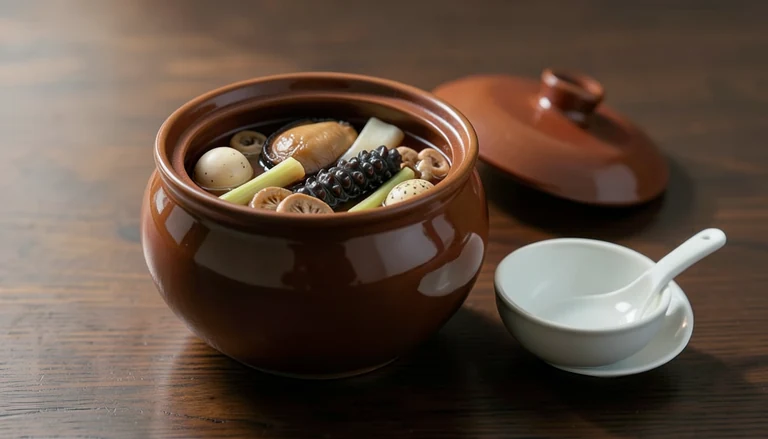
A slow-cooked Fuzhou casserole of abalone, sea cucumber, fish maw, scallops and poultry, cooked in a wine jar.
Get to know the dish
Buddha jumps over the wall comes from Fuzhou. The Fujian provincial government says the Juchunyuan restaurant’s recipe is national-level intangible cultural heritage; China Daily dates the listing to 2008 and credits the dish to Juchunyuan’s founder, Zheng Chunfa, in the Guangxu era, when it was called fushouquan. The ingredients go through several stages of preparation, then are layered and slow-cooked in a Shaoxing wine jar over a low flame; the provincial page counts more than thirty ingredients and seasonings. The name has several legends. A Fujian government feature says a poet named it, claiming even Buddha would jump over the wall to eat it, and the MICHELIN Guide tells a version set at the table of the provincial governor Zhou Lian.
What to look for
A glossy, deeply savory broth with many separately prepared pieces you can tell apart. China Daily lists poultry, fish maw, abalone, sea cucumber and dried scallops, and the MICHELIN Guide says the Fujian broth is built on chicken and duck stock and turns glossy and amber-brown.
Every kitchen has its version
Ingredient counts and cooking times differ between tellings, from one to two days in a Fujian government feature to an eight-hour lotus-leaf-sealed simmer at one restaurant profiled by the MICHELIN Guide. Older lists include shark fin, which China Daily’s 2025 list omits; NOAA says US federal law has prohibited selling or buying shark fin products since December 23, 2022.
Regional versions
- Fujian style. The MICHELIN Guide says the Fujian dish is built on chicken and duck stock, producing a glossy, amber-brown broth.
- Cantonese style. Cantonese versions center on abalone sauce, according to the same MICHELIN Guide feature.
- Taiwanese style. The MICHELIN Guide says Taiwanese cooks pre-fry ingredients such as taro, crispy pork ribs and quail eggs so they absorb the broth.
- Ready to heat. Xinhua reports packaged versions that consumers only need to heat for a few minutes.
Questions people ask
Does Buddha jumps over the wall contain shark fin?
Some older recipes did: a Fujian government feature lists shark fin among possible ingredients. China Daily’s 2025 list names poultry, fish maw, abalone, sea cucumber and dried scallops instead. In the United States, NOAA says federal law has prohibited selling or buying shark fin products since December 23, 2022.
Why is it so expensive?
It combines premium dried seafood with long preparation. Xinhua describes days of steaming, frying and slow-braising each ingredient separately, and the Fujian provincial government counts more than thirty ingredients and seasonings. Ask the restaurant about price and whether it needs notice.
Is it a soup or a stew?
Something in between. China Daily calls it a single, aromatic casserole: the ingredients are slow-cooked together in a wine jar, so you get both a rich broth and substantial pieces of seafood and meat.
What allergens should I ask about?
Published ingredient lists include abalone, scallops, sea cucumber and fish maw, and some add quail eggs and pork; the jar is cooked with Shaoxing wine. Recipes vary, so ask the kitchen for its own list if you have an allergy.
Last reviewed
Sources & further reading
Background and preparation references. Our descriptions are editorial summaries, not restaurant reviews.
- Fujian provincial government — National ICH: Juchunyuan fotiaoqiang (opens in a new tab) ↗
- Fujian provincial government (China Daily) — Fuzhou fotiaoqiang and its culinary heritage (opens in a new tab) ↗
- Fujian provincial government — Local cuisine: Fuzhou, the umami capital (opens in a new tab) ↗
- People’s Daily (Xinhua) — Centuries-old delicacy leaps into global kitchens (opens in a new tab) ↗
- MICHELIN Guide — Buddha Jumps Over the Wall at MICHELIN restaurants (opens in a new tab) ↗
- NOAA Fisheries — Shark Fin Sales Elimination Act of 2023 FAQ (opens in a new tab) ↗