Lychee pork
荔枝肉
Lì zhī ròu
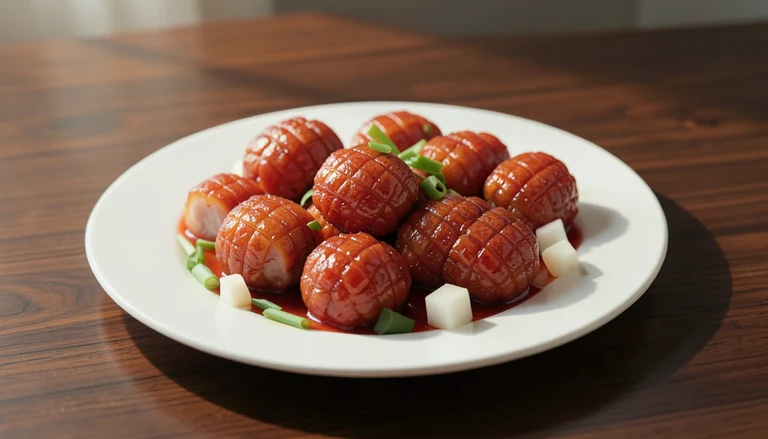
Crosshatch-scored pork that curls like lychee skin when fried, glazed sweet and sour with water chestnuts.
Get to know the dish
Lychee pork contains no lychee. A Fujian provincial government feature on Fuzhou food describes small, round pieces of pork and sliced water chestnut in a sweet and sour sauce, named because the shape and color resemble lychee skins; in typical Fujian style, red wine lees give the red-to-orange color. Chinese Cooking Demystified calls it a classic dish from Fuzhou, a Fujian-style sweet and sour whose basis is vinegar. The World of Chinese retells a Tang dynasty legend about a homesick consort from Putian, and notes that the earliest reliable record is in Yuan Mei’s Qing dynasty Suiyuan Shidan, where pork slices are boiled, fried and stewed in wine and soy sauce.
What to look for
Pieces scored in a fine crosshatch that curl into knobbly balls, glossy with red sauce, with crisp water chestnut between them. A Fuzhou chef quoted by China Daily says the cuts must be two-thirds deep so the pork curls like lychee fruit when fried.
Every kitchen has its version
Home and banquet versions differ. Chinese Cooking Demystified gives a homestyle version with potatoes and a banquet version that looks much like lychees, colored with red yeast rice or hongzao. The World of Chinese adds that water chestnuts are sometimes replaced with potatoes or sweet potatoes. Scoring depth ranges from Chinese Cooking Demystified’s shallow cuts to two-thirds deep.
Regional versions
- Fuzhou banquet version. Chinese Cooking Demystified’s banquet version is shaped to look like lychees and colored with red yeast rice or hongzao red wine lees.
- Homestyle with potatoes. Chinese Cooking Demystified and The World of Chinese both describe potatoes standing in for water chestnuts.
- Qing dynasty recipe. The World of Chinese says Yuan Mei’s Suiyuan Shidan boils pork slices, fries them and stews them in wine and soy sauce.
Questions people ask
Does lychee pork contain lychee?
No. The Fujian provincial government says the name comes from the shape and color of the finished pork, which resemble lychee skins. The pork is scored so it curls into a round, bumpy shape when fried.
What makes lychee pork different from other sweet and sour pork?
The scoring. A Fuzhou chef quoted by China Daily says the cuts go two-thirds deep and the meat, both lean and fat, is lightly coated with starch so the lychee-skin pattern shows through the glaze. Chinese Cooking Demystified says the Fujian sweet and sour starts from vinegar.
What makes lychee pork red?
Red wine lees in the Fujian government’s description, red yeast rice flour in The World of Chinese recipe, and red yeast rice or hongzao in Chinese Cooking Demystified’s banquet version. Ask the kitchen if it matters to you.
Why is Fujian food sweet and sour?
One Fuzhou chef told China Daily that Fujian’s winding waterways and mountain roads often cause motion sickness and the sweet-and-sour flavor helps settle the stomach. Treat that as one cook’s explanation rather than settled history.
Last reviewed
Sources & further reading
Background and preparation references. Our descriptions are editorial summaries, not restaurant reviews.
- Fujian provincial government — Local cuisine: Fuzhou, the umami capital (opens in a new tab) ↗
- Chinese Cooking Demystified — Lychee pork (opens in a new tab) ↗
- The World of Chinese — Fruit of the south (opens in a new tab) ↗
- China Daily (China Services Info) — The soul of Fujian cuisine (opens in a new tab) ↗