Squirrel fish
松鼠鳜鱼
Sōng shǔ guì yú
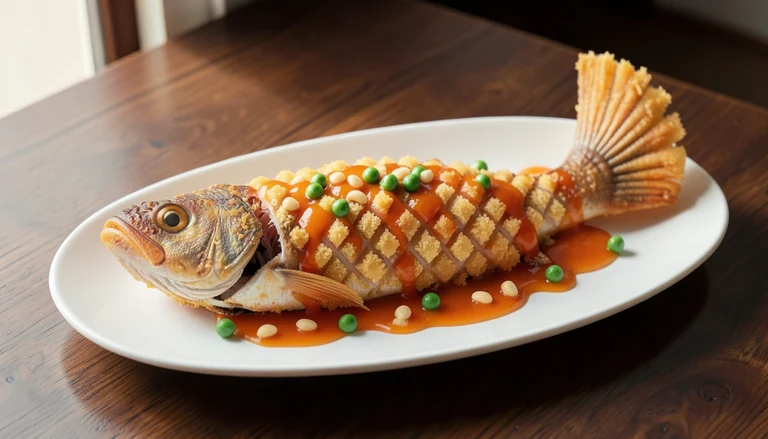
A boned, diamond-scored mandarin fish fried so its flesh fans out like a squirrel’s tail, in sweet and sour sauce.
Get to know the dish
Squirrel fish is a Suzhou dish. China’s Ministry of Culture and Tourism describes the method: after cleaning and deboning, the flesh is turned outward, scored with diamond-pattern cuts, dusted with starch and deep-fried with the head slightly raised and the tail arched high, and hot sweet-and-sour sauce is poured over it. China Daily says the fried flesh splays into fluffy, golden layers like a squirrel’s bushy tail, and the hot sauce makes the fish sizzle with a chirping sound. Legend credits the Qianlong emperor with tasting it at the Songhelou restaurant in Suzhou; Atlas Obscura says he popularized it in the 18th century.
What to look for
Crisp, golden, diamond-cut flesh fanning out from the skin, a raised tail and a glossy orange-red sauce, with green peas and pine nuts on top in both The Woks of Life’s recipe and The Infatuation’s description.
Every kitchen has its version
The sauce has changed over time. China Daily reports that the original used vinegar, soy sauce and sugar, and that ketchup entered the sauce through Shanghai restaurants in the early 20th century; the ministry and The Infatuation now describe ketchup, sugar and vinegar. Overseas kitchens swap the fish: China Daily says Songhelou’s London branch uses sea bass, and The Woks of Life suggests sea bass, freshwater bass or branzino.
Regional versions
- Suzhou method. Deboned, diamond-scored and deep-fried with the head raised and tail arched, then sauced, per China’s Ministry of Culture and Tourism.
- Pre-ketchup sauce. China Daily reports the original sauce combined vinegar, soy sauce and sugar before ketchup arrived through Shanghai restaurants.
- US substitutes. The Infatuation says US restaurants often use tilapia or rockfish in place of hard-to-source mandarin fish.
- Home version. The Woks of Life fillets the fish but keeps the two fillets attached at the tail and fries them in one piece; the recipe serves 4.
Questions people ask
Why is it called squirrel fish?
Two reasons appear in sources. The fried, splayed flesh and raised tail look like a squirrel’s bushy tail, and Atlas Obscura and China Daily say the fish squeals or chirps when the hot sauce hits it.
Does squirrel fish have bones?
The body is deboned before frying, according to China’s Ministry of Culture and Tourism, but the head and tail stay on. Ask the kitchen if you want to avoid small bones entirely.
Why is squirrel fish expensive?
Atlas Obscura says mandarin fish is expensive and the dish is not easy to make. China Daily reports that one Suzhou chef’s restaurants give a fish of about 1 kilogram exactly 108 cuts. Ask the price and the fish size before ordering.
Is squirrel fish spicy?
No. It is sweet and sour, and Visit Beijing’s Jiangsu guide says the region’s dishes tend to have subtle, sweet flavours and shy away from spice. Pine nuts are a common garnish, so mention tree-nut allergies.
Last reviewed
Sources & further reading
Background and preparation references. Our descriptions are editorial summaries, not restaurant reviews.
- Ministry of Culture and Tourism of China — Suzhou squirrel fish (opens in a new tab) ↗
- China Daily (China Bound) — A twist in the tail: squirrel fish reels in global foodies (opens in a new tab) ↗
- The Woks of Life — Sweet and sour squirrel fish (opens in a new tab) ↗
- The Infatuation — Squirrel fish kept my family connected during the pandemic (opens in a new tab) ↗
- Atlas Obscura — The regional Chinese cuisine linked to an ancient assassin (opens in a new tab) ↗
- Visit Beijing — Jiangsu cuisine (opens in a new tab) ↗