
Choose steamed soup dumplings or a crisp-based bun
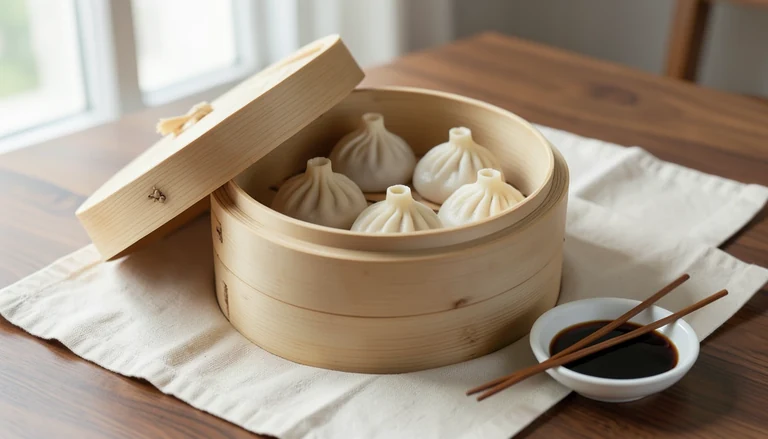
Xiaolongbao (小笼包, xiǎo lóng bāo) arrive steamed in the small bamboo basket that cooked them: a thin pleated wrapper around pork and gelled broth. Sheng jian bao (生煎包, shēng jiān bāo) are pan-fried buns with a browned, crackling base, often holding the same sort of broth. Pick the basket if you want a delicate wrapper and a burst of soup; pick the pan if you want chew, crunch and a bready top.
The two names are not opposites on a spice scale. Both are mild, both are pork by default, and both can be soupy. What separates them is the dough and the heat source: steam for one, oil and a covered pan for the other. The Shanghai municipal government calls xiaolongbao soup dumplings in English and describes shengjian as pan-fried pork buns, which is a fair summary of the difference.
| Decision | Xiaolongbao / 小笼包 | Sheng jian bao / 生煎包 |
|---|---|---|
| Cooking method | Steamed in a small bamboo basket | Shallow-fried, then steamed under a lid |
| Wrapper or dough | Thin wheat wrapper, unleavened or partly raised | Semi-leavened or fully leavened bun dough |
| Where the soup is | Inside, from pork-skin aspic that melts | Inside in the hunshui style; the qingshui style adds no aspic |
| Texture | Delicate, slippery wrapper; hot broth inside | Chewy top, crisp fried base; breadier in the qingshui style |
| Origin city | Nanxiang, now part of Shanghai; modern form dated 1871 | Suzhou in the early 1910s; in Shanghai tea houses by the 1920s |
| How to eat | Lift by the pleat onto a spoon, open, sip, then dip | Spoon, open, sip, eat the pork, then dip the base in vinegar |
| English menu names | Soup dumplings, steamed soup dumplings, XLB | Pan-fried pork buns, shengjian bao, shengjian mantou |
Trace two histories, and treat the older genealogy as tradition
The Shanghai municipal government traces the ancestry of xiaolongbao to taixue mantou, a stuffed steamed bun sold to scholars in Bianjing, now Kaifeng, during the Northern Song dynasty. It says migrants carried wheat-based cooking south, where northern dough met Jiangnan ingredients. The modern bun it dates to 1871, when Huang Mingxian, who ran the Ri Hua Xuan shop in Nanxiang, shrank the meat bun, thinned its skin and mixed in meat jelly that turned to soup during steaming. His buns became Nanxiang xiaolongbao, and the form spread through Shanghai.
The encyclopedia files the bun under tangbao, the wider family of soup-filled buns steamed in small baskets, and credits Shanghai with the bun as it is known today while tracing its line back to Kaifeng guantangbao. Read the Song-dynasty genealogy as inherited tradition rather than a documented birthday: neither page names a first cook or a surviving recipe before 1871.
Sheng jian bao have a shorter, better-dated story. The Shanghai government places their beginning in Suzhou, just across the border, in the early 1910s; by the 1920s Shanghai tea houses and the local hot-water shops known as laohuzao, or tiger stoves, were selling them as an everyday bite. Wikipedia calls shengjian a specialty of Suzhou and Shanghai and says its popularity spread across the Yangtze River Delta.
The word mantou is part of the confusion. The full name is shengjian mantou (生煎馒头). The Shanghai government notes that the term once covered any filled bun; northern cooking later reserved mantou for the plain version and baozi for the filled one, while Shanghai and the wider Jiangnan region held to the older sense. Wikipedia records the same split and adds that xiaolong mantou follows it too. So 生煎馒头 and 生煎包 name one bun, not two.
How the soup gets in, and how each one cooks
Xiaolongbao rely on aspic. The Woks of Life simmers pork skin with meaty pork neck bones, ginger, scallion and Shaoxing wine for two hours, strains the liquid, chills it overnight, dices the set jelly and folds the cold cubes into seasoned pork. Steaming melts the jelly into soup. The Shanghai government tells the same story from the other side, crediting Huang's 1871 addition of meat jelly with the soup, and noting that the wrapper must be thin and soft yet strong enough to keep it in.
The pleats are structural. Wikipedia says Jiangnan buns are pinched at the top before steaming, leaving a circular cascade of ripples around the crown. The Shanghai government says Huang insisted on neat folds, thin dough and fresh pork. A collapsed or leaking bun is a wrapper problem before it is a filling problem.
Sheng jian bao are fried first and steamed second. Wikipedia describes semi-leavened dough wrapped around pork and gelatin, the buns lined in an oiled shallow pan with the folded knot facing down, water sprayed in, and a lid trapping the steam; the bottoms crisp while the tops cook, and the tightly packed buns end up somewhat cube-shaped. The Shanghai government separates two styles: hunshui, where a partly raised dough is pleated side down over pork enriched with pork-skin aspic, and qingshui, where a fully raised dough is pleated side up and the aspic is left out, giving a breadier bite.
The Woks of Life home recipe shows the timing: shallow-fry for 8 to 10 minutes, add water to about half an inch, cover for another 8 to 10, then finish with sesame and scallion for 5 minutes more. It also warns that the soup can be scalding and that a cooling bun absorbs its own broth, which is why the buns are served immediately.
Read the dough before you read the filling
A xiaolongbao wrapper is thin enough to show the filling through it and to pass heat quickly. A sheng jian bao is a bun: the dough is chewier at the top and crisp underneath, and the qingshui style is deliberately breadier. That is why the same pork-and-soup filling feels like two different foods.
Soup is not a reliable test on its own. A hunshui shengjian carries aspic, so it can be as soupy as a xiaolongbao; a qingshui shengjian relies on the juices of the meat and may be barely wet. A xiaolongbao without broth is a failure of the form rather than a variant, because the jelly is what the wrapper is built to hold.
Portions differ too. The Shanghai government says shengjian are ordered by the liang, a weight of 50 grams that in this context means a portion of four buns; the page explains that a liang of flour used to yield exactly that many. Xiaolongbao counts are set by the shop. In our own price index, the standard soup-dumpling orders that state a count run from 3 to 32 pieces, which is one reason a per-order price is hard to compare.
Regional versions change the wrapper, the sweetness and the name
Wikipedia lists several xiaolongbao styles. Suzhou and Wuxi buns are larger, sometimes twice a Nanxiang bun, with sweeter fillings; those from Nanjing are smaller still, with skin thin enough to see through and a smaller share of meat; Changzhou is known for crab-filled buns eaten after the Mid-Autumn Festival; Hong Kong's take looks like the Changzhou bun, yet ginger and sometimes scallion in the filling make it gently spicy and the wrapper chewier, and menus there still call it Shanghai xiaolongbao. Outside China, it says, the Nanxiang style is the one most often served.
Shengjian vary by shop and city. Wikipedia says Shanghai buns typically have thin, crisp skins while those sold elsewhere usually have thicker, bread-like ones, and it names chicken, pork-with-prawn and pork-with-crab fillings alongside the standard pork. The Shanghai government treats Da Hu Chun, founded in 1932, as a leading qingshui shop with fully fermented dough and a cracker-like base, and Yang's Fry-Dumpling, which it says has popularized an unleavened, thin-skinned, broth-heavy version since 1994, as the modern counterpoint.
English names are where menus blur. Xiaolongbao appear as soup dumplings, steamed soup dumplings, steamed buns or XLB. Sheng jian bao appear as pan-fried pork buns, shengjian bao or shengjian mantou. Steamed buns on a US menu can also mean a large fluffy baozi, and pan-fried buns can mean a yeast-raised bun with no soup at all. Read the characters when they are printed: 小笼包 for the steamed basket bun, 生煎包 for the fried one.
Wikipedia adds that soup dumpling in English can cover the wider tangbao family, including Kaifeng tangbao, so the phrase is a category rather than a single recipe. That is another reason to ask about the wrapper and the cooking method instead of matching words.
Eat one without scalding your mouth
The Shanghai government prints a four-step rule for xiaolongbao: lift the bun gently by its folded top with chopsticks, set it on a spoon, bite a small opening to let the steam out, then sip the soup before eating the rest. Vinegar and shredded ginger are served alongside if you want them.
Its order for shengjian is similar but ends with the dip. Put the bun on a spoon, open the top, sip the broth, enlarge the opening and eat the pork, then dip the crisp bottom and dough in vinegar. The page says locals avoid vinegar during the first two steps so the aroma of the meat comes through.
The Woks of Life serves shengjian with Shanghai rice vinegar, which it describes as lighter and less overpowering than the black vinegar used for soup dumplings, and repeats the warning that the soup inside can be scalding. Give a freshly opened bun a moment before the second bite, and keep the spoon under it; the broth is the point and it is also the hazard.
What our dumpling price index does and does not count
The site's Dumpling Price Index reads listed prices from the same city-guide records used elsewhere here. It holds 423 soup-dumpling listings from 236 restaurants in 126 cities. Its standard comparison, which excludes crab, truffle, pan-fried and sheng jian listings, covers 312 orders from 230 restaurants in 123 cities, with a median order price of $11.98 and a listed range of $3.99 to $48.99.
Piece counts matter more than order prices. Of those standard orders, 209 state how many dumplings come in the order, and the median works out to $1.69 a piece; stated order sizes run from 3 to 32 pieces. The index deliberately keeps sheng jian bao out of the soup-dumpling median, so this page does not quote a sheng jian price from it.
Use the index for what it measures: the price next to a named menu item on a dated page, before tax, tip and fees. It does not measure quality, and it does not tell you whether the dumplings are good. The full table, chart and CSV are on the soup-dumpling price page.
Five US menus that name the steamed bun or the fried one
Special Noodle in Pleasanton is the clearest single page in our data: its operator-linked ordering menu, read on 2026-10-08, lists 小笼包 (8个) Steamed Soup Dumplings at $13.49 and 生煎包 (6个) Soup Pan Fried Buns at $14.49 on the same menu. That is one kitchen offering both forms with the characters printed.
1st Dumpling N Noodle, in neighboring Montclair on the Pomona guide, lists Kurobuta Pork Xiao Long Bao at $12.99 and Kurobuta Sheng Jian Bao at $13.99, described as Pork, Egg, Broth, on its MealKeyway pickup menu, checked 2026-10-09. The broth description is the operator's, not a tasting note from this site.
Little Pan in Santa Ana describes its own project on its website: We keep the soupy style from Xiaolongbao with the panned crispy bottom. Its Chowbus menu, read 2026-10-09, lists Special Xiao Long Bao/8pcs at $12.99 and House Special Pan-Fried Pork Bun, 6 counts, at $11.99.
Nan Xiang Xiao Long Bao in Flushing lists Soup Dumplings (6) and Pan-Fried Pork / Crabmeat Buns on its menu page, checked 2026-09-30. The bun line does not print 生煎, so it is evidence of a pan-fried bun, not proof of the Shanghai shengjian style. Shanghai Delight in Milpitas says on its own site that it makes its soup dumplings daily; that page was read on 2026-10-27.
That is the honest state of our data. Plenty of records list pan-fried pork buns or juicy dumplings without either Chinese name, and several say nothing about aspic, so they cannot be counted as sheng jian bao. We have not visited these restaurants, and nothing here is a rating or a review.
Ask three questions and the menu stops being ambiguous
Begin with the cooking method: is the order steamed or pan-fried? Then ask what the wrapper is made of, and whether the filling contains aspic or added broth. Those two answers separate a xiaolongbao, a hunshui shengjian and a qingshui shengjian more reliably than the English name.
Ask for the count and the price basis as well. A shengjian order is often four buns to a liang, while xiaolongbao baskets run from a handful to a catering tray, and a price without a count does not compare. Ask about crab if it is the reason you are ordering, since the Shanghai government lists crab roe as an autumn filling and other seasonal greens and vegetables at other times of year.
Finally, mention pork, shellfish, egg and wheat if they matter to someone at the table. The wrappers and buns are wheat-based, the classic fillings are pork, and crab and shrimp versions are common. A kitchen can describe its own dough and fillings; the menu name usually cannot.
Questions people ask
What is the difference between xiaolongbao and sheng jian bao?
One is steamed in a basket and one is fried in a pan. Xiaolongbao use a thin pleated wheat wrapper around pork and gelled broth. Sheng jian bao use a leavened or semi-leavened bun dough and get a crisp base from shallow-frying. Both can hold broth, so ask about the filling rather than judging by the English word soup.
Are sheng jian bao a kind of soup dumpling?
In English, soup dumplings usually means xiaolongbao or the wider tangbao family. Sheng jian bao are pan-fried buns. The hunshui style holds pork-skin aspic that melts into broth; the qingshui style adds no aspic and tastes more like bread. The Shanghai government page separates those two styles.
Which one is soupier?
It depends on the sheng jian bao. Hunshui buns carry aspic in the same way xiaolongbao do, while qingshui buns rely on the juices of the meat. Xiaolongbao are built around the broth, so a dry one is a fault in the form rather than a recognized style.
How do you eat xiaolongbao without burning your mouth?
Lift one by its pleated top onto a spoon, make a small opening, let the steam out, sip the soup, then eat the rest. The Shanghai government prints the sequence as lift gently, move slowly, open a small window, then drink the soup. Vinegar and shredded ginger are optional.
Do you dip sheng jian bao in vinegar?
Yes, but the Shanghai government puts the dip last: sip the broth, eat the pork, then dip the crisp bottom and dough. The Woks of Life serves them with Shanghai rice vinegar, which it calls lighter than the black vinegar used for soup dumplings.
Why do menus call sheng jian bao shengjian mantou?
In Jiangnan, mantou still covers filled buns, while northern Chinese cooking later split plain mantou from filled baozi. So 生煎馒头 and 生煎包 name the same bun. The Shanghai government and Wikipedia both describe that older usage.
Menu words in this guide
Last reviewed
Sources & further reading
Background and preparation references. Our descriptions are editorial summaries, not restaurant reviews.
- Shanghai municipal government — Xiaolongbao: a small dumpling with a big story (opens in a new tab) ↗
- Shanghai municipal government — Pan-fried pork buns (opens in a new tab) ↗
- Wikipedia — Xiaolongbao (opens in a new tab) ↗
- Wikipedia — Shengjian mantou (opens in a new tab) ↗
- The Woks of Life — Steamed Shanghai soup dumplings (xiaolongbao) (opens in a new tab) ↗
- The Woks of Life — Shanghai pan-fried pork buns (shengjian mantou) (opens in a new tab) ↗
- Special Noodle — operator-linked Pleasanton menu, read 2026-10-08 (opens in a new tab) ↗
- 1st Dumpling N Noodle — MealKeyway pickup menu, checked 2026-10-09 (opens in a new tab) ↗
- Little Pan — Santa Ana Chowbus menu, read 2026-10-09 (opens in a new tab) ↗
- Little Pan — operator description of the pan-fried bun (opens in a new tab) ↗
- Nan Xiang Xiao Long Bao — menu page, checked 2026-09-30 (opens in a new tab) ↗
- Shanghai Delight — home page on daily soup dumplings, read 2026-10-27 (opens in a new tab) ↗