
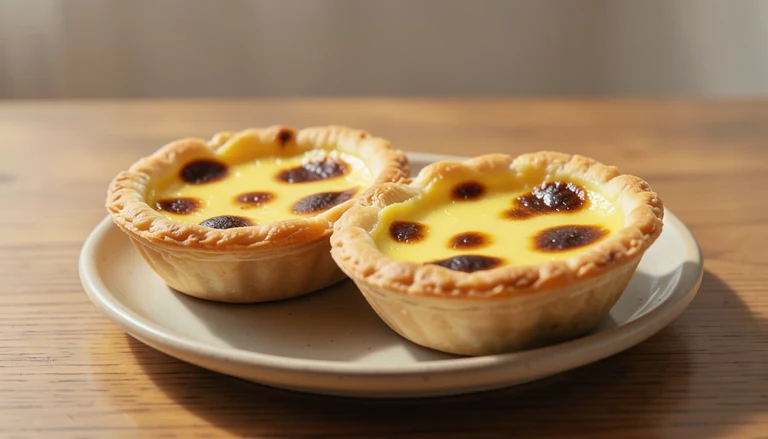
Compare the top and crust before trusting the label
Hong Kong egg tarts commonly present a smooth yellow custard top, while Portuguese pastel de nata and the familiar Macao-style tart show browned patches above layered pastry. Hong Kong tarts can use either shortcrust or puff pastry, so 'Hong Kong means shortcrust' is too narrow. Look at the top, ask about the shell and check which recipe the bakery means.
There are three useful categories to keep separate: Hong Kong dan taat, Portuguese pastel de nata and Macao adaptations often sold as Portuguese-style egg tarts. Related names do not make their fillings or flavors identical. The Macao example discussed here is a particular bakery's adaptation, not a recipe assigned to every browned tart in Asia.
For a first comparison, order one smooth-topped Hong Kong-style tart and one browned Portuguese or Macao-style example if the bakery offers both. Choose them at a similar serving temperature, and ask the staff to identify the crusts. That gives you a clearer comparison than guessing from two labels alone.
Use this crust, custard and top comparison
The table separates a general style cue from the actual reference preparations. Hong Kong Tourism Board supplies the two-crust distinction; Manteigaria describes its own Portuguese tart; a Macao Magazine interview supplies the Lord Stow's recipe account. These are comparisons of described products, not a taste test or a ranking.
| Style | Crust | Custard and top | Useful question |
|---|---|---|---|
| Hong Kong dan taat | Shortcrust or puff pastry | Smooth yellow custard is the familiar cue | Which crust does this bakery use? |
| Portuguese pastel de nata | Layered pastry in the comparison here | A browned top; Manteigaria describes a velvety filling | Is this the bakery's Portuguese recipe? |
| Macao-style, Lord Stow's example | Puff pastry | Egg, milk and cream custard with a scorched surface in the interview account | Is this a Macao adaptation, and how is it flavored? |
Hong Kong egg tarts include two shell directions
The Hong Kong Tourism Board explicitly describes shortcrust and flaky or puff-pastry bases for egg tarts. Shortcrust gives you a different shell to compare with a laminated pastry version. A smooth yellow top can therefore sit inside more than one kind of crust; the filling's appearance does not identify the shell by itself.
The Woks of Life's Hong Kong egg tart recipe provides a concrete flaky-pastry example and a filling made with eggs, evaporated milk and sugar water. That recipe supports an ingredient example, not a claim that every bakery uses evaporated milk or the same proportion of eggs.
If you want to compare crusts specifically, ask whether the bakery sells two Hong Kong versions. Keeping the custard style similar while changing the shell can answer a different question from comparing Hong Kong and Macao tarts at once. Ask the staff which is which before you carry the pair away.
Portuguese pastel de nata is a category with particular bakeries
Pastel de nata is the singular name; pastéis de nata is the plural you will see on Portuguese bakery sites. Manteigaria describes its tart through thin crisp pastry and a velvety filling. It is an actual bakery reference that helps connect the name to the pastry-and-custard structure rather than to a country's flag on a menu.
Pastéis de Belém is also a specific bakery name and product. Its own history dates production to 1837 and describes a guarded recipe passed among its confectioners. Attribute that history to the bakery rather than assuming every pastel de nata follows its secret formulation.
At another counter, ask how its Portuguese tart is flavored and which pastry it uses. Cinnamon, citrus, sweetness and custard texture are details to confirm in that preparation. A national style label cannot provide an ingredient list or settle which version you would prefer.
Macao's Portuguese-style tart is an adaptation to name clearly
In a January 2023 Macao Magazine interview, Lord Stow's director Eileen Stow describes Andrew Stow developing his own tart without a Portuguese recipe to follow. The account identifies puff pastry and an egg, milk and cream filling, explains its English-custard direction and dates the bakery's establishment to 1989.
The same interview explains that local speakers used a Portuguese-tart name to distinguish the creation from Hong Kong dan tat. That naming history matters: the label can indicate a Macao adaptation even when the tart was baked elsewhere. It should not erase the difference between that product and a Portuguese bakery's pastel de nata.
Use the shop's description to decide what you are buying. Ask whether it means a Macao-style adaptation, a Portuguese recipe or simply a browned custard tart. A clear answer is more useful than trying to settle the entire history of egg tarts at the counter.
A browned top is a clue, not a complete recipe
Browning helps orient the comparison, but it does not establish the dairy, egg proportions, flavorings or pastry fat. The smooth-topped Hong Kong recipe here contains evaporated milk; the described Macao example contains milk and cream. Those are two named preparations, not a rule that divides all bakeries into milk-free and milk-containing camps.
If an ingredient matters, ask about the complete tart, including the shell. The words egg tart already name one component but do not list all the others. A butter-like flavor does not tell you every fat used in a crust, and a yellow filling does not disclose whether milk or another ingredient is present.
For an ordinary preference, ask which tart has the crust and custard texture you enjoy. Describing a crumbly shell, a flakier shell or a smoother top lets the staff make a practical comparison within their own range.
Compare at the counter without turning it into a ranking
Ask which tarts were baked most recently and how the bakery recommends serving them. If you buy a pair to compare, note the temperature and whether one has spent longer in a takeaway box. Those conditions are part of the eating experience and can obscure the crust difference you wanted to understand.
Look first at the pastry edge and top, then pay attention to how much of the bite comes from shell versus custard. You may prefer a smooth-topped tart on one occasion and a browned one on another. There is no need to turn that preference into a claim that one city or country makes the best version.
For takeaway, get storage and reheating instructions from the bakery for its exact product. This article compares ordering categories; it does not assign a single shelf life or heating schedule to different recipes.
Make your next tart order precise
A useful order is 'a Hong Kong egg tart with puff pastry' or 'your Macao-style browned tart,' followed by a question about any flavoring you want to check. If the bakery offers only one style, its own description can still tell you more than the generic English word egg tart.
After choosing the tart, the wider bakery guide can help you add a bread or filled bun with a different texture. At dim sum, check the piece count and whether the tart needs another order round. The egg-tart comparison answers which style you want; the rest of the meal remains a separate choice.
Questions people ask
What is the main difference between Hong Kong and Portuguese egg tarts?
A smooth yellow top is a useful Hong Kong-style cue, while the Portuguese and Macao examples here have browned tops and layered pastry. Hong Kong tarts can use either shortcrust or puff pastry, so ask about the shell as well as the custard.
Are all Hong Kong egg tarts made with shortcrust pastry?
No. Hong Kong Tourism Board describes shortcrust and puff-pastry versions. The Woks of Life's Hong Kong recipe is a flaky laminated-pastry example.
Is a Macao Portuguese-style egg tart identical to pastel de nata?
Do not assume that. The Lord Stow's director interview describes a distinct adaptation using puff pastry with an English-custard direction. Ask which recipe the bakery means by Portuguese-style.
Does an egg tart contain milk?
The reference preparations here do: the Hong Kong recipe uses evaporated milk, and the Macao account describes milk and cream. Ask the bakery about the complete filling and crust rather than treating these examples as a universal recipe.
Menu words in this guide
Last reviewed
Sources & further reading
Background and preparation references. Our descriptions are editorial summaries, not restaurant reviews.
- Hong Kong Tourism Board — Egg tart crust variations (opens in a new tab) ↗
- Hong Kong Tourism Board — Dan taat on a dim sum menu (opens in a new tab) ↗
- The Woks of Life — Hong Kong egg tart recipe example (opens in a new tab) ↗
- Manteigaria — The bakery's pastel de nata description (opens in a new tab) ↗
- Pastéis de Belém — The bakery's history (opens in a new tab) ↗
- Macao Magazine — January 2023 interview with Lord Stow's director (opens in a new tab) ↗