Fish head with chopped chili
剁椒鱼头
Duò jiāo yú tóu
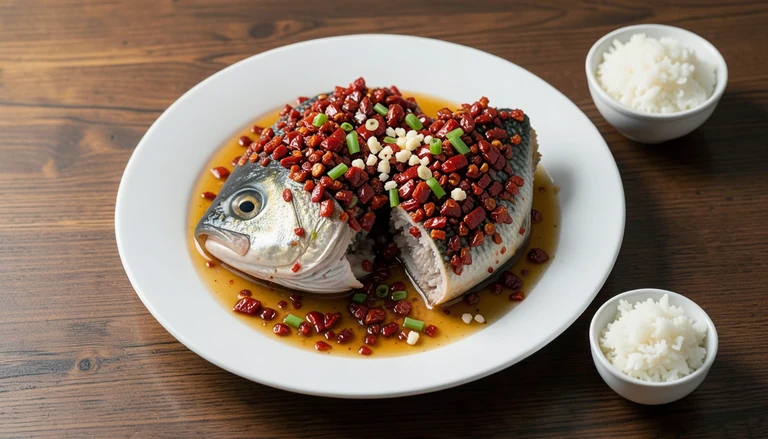
A split fish head steamed under a thick layer of salted, fermented red chili, with juices meant for noodles.
| Fact | Detail |
|---|---|
| Heat | Hot |
| Main protein | Fish, often bighead carp |
| Region | Hunan |
| Common menu names | Fish head with chopped chili, steamed fish head with chopped chili |
Duo jiao yu tou, chopped chili over a head
Fish head with chopped chili is 剁椒鱼头, duò jiāo yú tóu. The Woks of Life translates duo jiao (剁椒) literally as chopped chili peppers, and says the chilies are chopped and pickled in brine. (The Woks of Life — What is duo jiao? (opens in a new tab), read ) Its Hunan fish recipe also prints a correction to an earlier mistranslation of the name as lots of peppers. (The Woks of Life — Hunan steamed fish with salted chilies (opens in a new tab), read )
Wikipedia places the cooking in Hunan, also called Xiang cuisine, and describes a western Hunan style that uses preserved meat and pickled vegetables and tastes sour, spicy and salty. (Wikipedia — Hunan cuisine (opens in a new tab), read ) The World of Chinese describes Hunan food as hot and sour, with a dry heat rather than the numbing burn of Sichuan cooking, and says the province’s rivers and lakes supply freshwater fish. (The World of Chinese — Flavor in a fish head (opens in a new tab), read )
That geography is the logic of the plate. A large freshwater head is steamed, and a preserved chili topping does the seasoning. The World of Chinese says bighead carp is often the fish, and that its head is large and scaleless, which the article calls ideal for the dish. (The World of Chinese — Flavor in a fish head (opens in a new tab), read )
Split, salted, covered in chili, steamed
The World of Chinese gives a home method in order. The gills come out, but the meat around them stays. The head is split at the chin and opened flat with the skin left intact, and shallow cuts are made in the thick meat. Cooking wine goes over both sides, then salt and pepper, and the head rests for five minutes. Ginger, leek and garlic slices form a bed on the plate, the head goes on top, and salted red peppers cover it. It steams for 8 to 10 minutes. Chopped spring onion and garlic go on last, and oil heated until it just smokes is poured over the top. (The World of Chinese — Flavor in a fish head (opens in a new tab), read )
The Woks of Life takes a different route at home. A fillet sits on sliced tofu. A mix of soy sauce, jarred Hunan chilies and a little sugar goes over it, rinsed whole fermented black beans are scattered on top, and the plate steams for 12 minutes, until the fish is opaque and a butter knife slides in without resistance. (The Woks of Life — Hunan steamed fish with salted chilies (opens in a new tab), read )
The two recipes agree on the shape of the dish and disagree on almost everything else: head or fillet, salt or soy, chili alone or chili with black beans, eight minutes or twelve. Those are kitchen choices, not a dispute about what the dish is.
What is in the jar of duo jiao
Duo jiao is not a sauce. The Woks of Life says the chilies stay in visible pieces and keep their bright red colour, and that the jar should not be confused with a fermented black bean chili sauce, which is a condiment used in small amounts. (The Woks of Life — What is duo jiao? (opens in a new tab), read ) It describes the taste as salty and slightly pickled, with moderate heat that varies by brand, and says an open jar keeps for several months in the refrigerator. (The Woks of Life — What is duo jiao? (opens in a new tab), read )
The Woks of Life’s Hunan fish recipe hedges the heat twice: the plate looks much spicier than it is, and it is still not a dish for someone new to spicy food. (The Woks of Life — Hunan steamed fish with salted chilies (opens in a new tab), read ) That pair of statements is useful at the table, because the colour of the topping tells you very little about the burn.
Xin Hunan adds one restaurant’s detail. In its interview, Tan Yan says a plate uses five kinds of chili, one of them fermented for more than three years, and that the fermentation takes the raw edge off the heat. (Xin Hunan (Hunan Daily) — 湘味里的非遗: 剁椒鱼头 (Chinese) (opens in a new tab), read ) That is her kitchen’s method as the paper reports it, not a recipe every Hunan cook follows.
A legend, a heritage listing, and how to order
The origin story is a legend. The World of Chinese tells of a scholar who fled the literary inquisition under the Yongzheng emperor, hid in a poor Hunan village, and was served fish heads steamed with the family’s chopped red peppers. (The World of Chinese — Flavor in a fish head (opens in a new tab), read ) Xin Hunan names the scholar as Huang Zongxian and tells a version in which a fisherman gives him a large fish head, which he covers with the household’s pickled chopped chili and steams. (Xin Hunan (Hunan Daily) — 湘味里的非遗: 剁椒鱼头 (Chinese) (opens in a new tab), read ) The two tellings differ in detail, and neither dates the dish to the event.
Xin Hunan reports that the preparation technique was added to Hunan’s provincial intangible cultural heritage list in 2023. (Xin Hunan (Hunan Daily) — 湘味里的非遗: 剁椒鱼头 (Chinese) (opens in a new tab), read ) That is a modern fact about the craft, and it does not make the legend a record.
Order it as a shared plate. The Woks of Life says the traditional service uses the upper part of the fish including the head, or sometimes only the head, and that a good deal of liquid comes out during steaming. (The Woks of Life — Hunan steamed fish with salted chilies (opens in a new tab), read ) The World of Chinese says the meat around the gills is said to be the most delicious part, and that restaurants sometimes leave some of the body attached. (The World of Chinese — Flavor in a fish head (opens in a new tab), read )
Ask which fish, how large the head is, and how hot the kitchen’s chili is. Then keep noodles in mind: the Woks of Life mixes them into the leftover sauce, which is why the dish is often served with noodles rather than tofu. (The Woks of Life — Hunan steamed fish with salted chilies (opens in a new tab), read ) The Milpitas guide lists a checked line written Fish Head w. Chopped Pepper, and the New York guide lists House Special Fish Head with Hunan Pepper. Those are menu names, not rankings. Hunan cooking is the regional page, Hunan versus Sichuan explains the dry heat, and Cantonese steamed fish is the clear-steamed relative.
Regional versions
- Split head, Hunan kitchen. The World of Chinese splits a 1.5-kilogram head at the chin, keeps the skin intact, scores the thick meat, steams it under salted red peppers for 8 to 10 minutes, then pours smoking oil over spring onion and garlic. (The World of Chinese — Flavor in a fish head (opens in a new tab), read )
- Fillet and tofu at home. The Woks of Life puts a tilapia or flounder fillet on sliced tofu, spreads a mix of soy sauce, jarred Hunan chilies and sugar over it, adds rinsed fermented black beans, and steams the plate for 12 minutes. (The Woks of Life — Hunan steamed fish with salted chilies (opens in a new tab), read )
- Head with part of the body. The World of Chinese says some restaurants leave some of the body attached because the head is not fleshy enough for every diner. (The World of Chinese — Flavor in a fish head (opens in a new tab), read ) The Woks of Life describes the traditional service as the upper part of the fish including the head. (The Woks of Life — Hunan steamed fish with salted chilies (opens in a new tab), read )
- Reservoir fish in a Changsha feature. Xin Hunan interviews Tan Yan, whom it calls the fourth-generation inheritor of the technique, and reports that her restaurants use bighead carp from large reservoirs that take at least three years to reach five jin, about 2.5 kilograms. (Xin Hunan (Hunan Daily) — 湘味里的非遗: 剁椒鱼头 (Chinese) (opens in a new tab), read ) That is one kitchen’s sourcing standard, reported by the paper, not a rule for the dish.
Questions people ask
What fish is used for the dish?
The World of Chinese says bighead carp (Hypophthalmichthys nobilis), called 胖头鱼, is often used, because its head is large and scaleless, and that other big-headed fish work too. (The World of Chinese — Flavor in a fish head (opens in a new tab), read ) The Xin Hunan feature describes reservoir-raised bighead carp at the restaurant it visits. (Xin Hunan (Hunan Daily) — 湘味里的非遗: 剁椒鱼头 (Chinese) (opens in a new tab), read ) Outside China the kitchen may use another fish, so ask which one.
How spicy is the chopped chili?
Usually less than it looks. The Woks of Life calls duo jiao salty and slightly tangy rather than fiery, says the heat varies by brand, and still warns that the dish is not for someone new to spicy food. (The Woks of Life — What is duo jiao? (opens in a new tab), read ) (The Woks of Life — Hunan steamed fish with salted chilies (opens in a new tab), read ) The World of Chinese says the first impression is heat and then the fish comes through. (The World of Chinese — Flavor in a fish head (opens in a new tab), read ) Ask about the jar the kitchen uses.
Is it only a fish head?
Usually the head, sometimes with part of the body. The Woks of Life says the traditional plate uses the upper part of the fish including the head, and sometimes only the head. (The Woks of Life — Hunan steamed fish with salted chilies (opens in a new tab), read ) The World of Chinese says some restaurants leave some body attached because the head is not fleshy enough for every diner, and that the meat around the gills is said to be the most delicious part. (The World of Chinese — Flavor in a fish head (opens in a new tab), read ) Expect bones.
What happens to the chili and juices at the bottom of the plate?
They are not waste. The Woks of Life boils noodles al dente, keeps them loose with a little oil, and mixes them into the sauce once some of the fish has been eaten; it says the dish is often served with noodles instead of tofu. (The Woks of Life — Hunan steamed fish with salted chilies (opens in a new tab), read ) The World of Chinese serves the plate with the chili and oil still on top and says to eat it hot. (The World of Chinese — Flavor in a fish head (opens in a new tab), read )
Where does fish head with chopped chili come from?
The origin is a legend. The World of Chinese tells of a scholar fleeing the literary inquisition under the Yongzheng emperor who hid in a poor Hunan village and was served fish heads steamed with the family’s chopped red peppers. (The World of Chinese — Flavor in a fish head (opens in a new tab), read ) Xin Hunan names the scholar as Huang Zongxian and tells a version in which a fisherman gives him a large fish head that he covers with pickled chopped chili and steams. (Xin Hunan (Hunan Daily) — 湘味里的非遗: 剁椒鱼头 (Chinese) (opens in a new tab), read ) It also reports that the preparation technique was added to Hunan’s provincial intangible cultural heritage list in 2023. (Xin Hunan (Hunan Daily) — 湘味里的非遗: 剁椒鱼头 (Chinese) (opens in a new tab), read )
Keep reading
Last reviewed
Where to eat fish head with chopped chili
From each restaurant’s checked menu; call ahead — menus change.
Chinese food in Frisco
- Hunan ChefSteamed Fish Head w/ Hot Pepper Sauce · Warren Parkway
Chinese food in Milpitas
- Hometown KitchenFish Head w. Chopped Pepper · Jacklin Road
Chinese food in New York
- Young and Rich NYHouse Special Fish Head with Hunan Pepper · Prince Street, Flushing
Sources & further reading
Background and preparation references. Our descriptions are editorial summaries, not restaurant reviews.
- The World of Chinese — Flavor in a fish head (opens in a new tab) ↗ read
- The Woks of Life — What is duo jiao? (opens in a new tab) ↗ read
- The Woks of Life — Hunan steamed fish with salted chilies (opens in a new tab) ↗ read
- Xin Hunan (Hunan Daily) — 湘味里的非遗: 剁椒鱼头 (Chinese) (opens in a new tab) ↗ read
- Wikipedia — Hunan cuisine (opens in a new tab) ↗ read