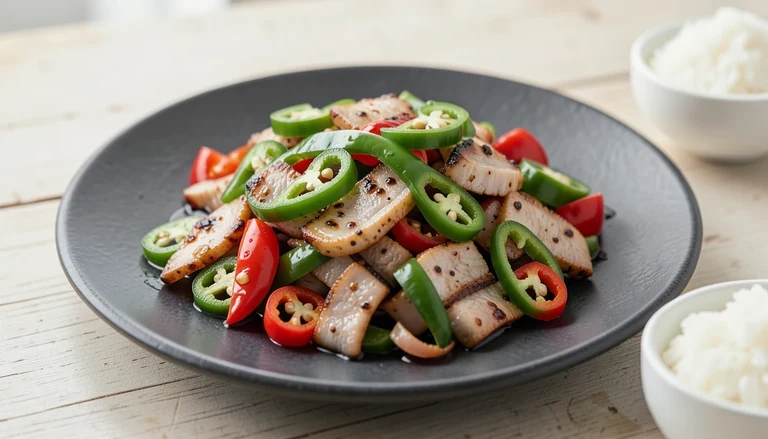
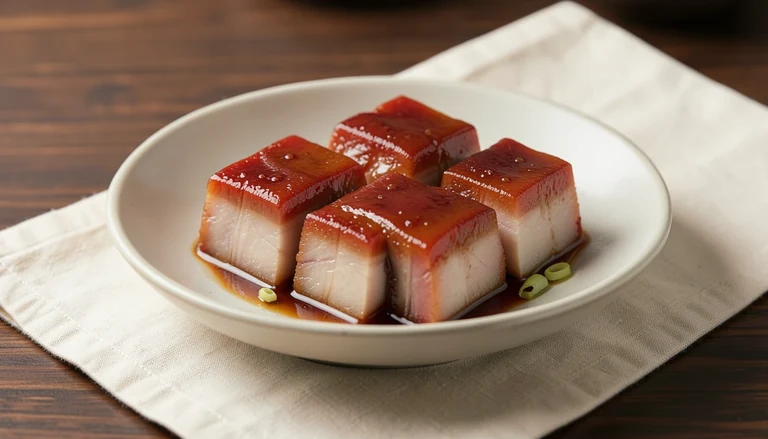
Hunan smoked pork stir-fry
炒腊肉
Chǎo là ròu
Salt-cured, smoked pork sliced thin and stir-fried, often with leeks and a little chili.
Get to know the dish
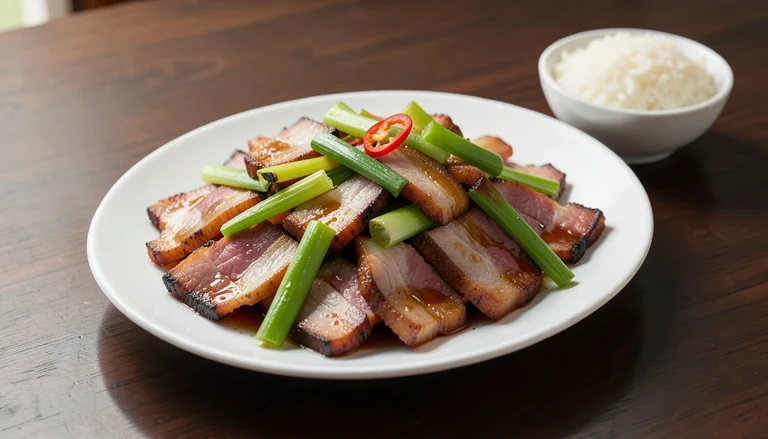
Cured meat from western Hunan is on the Hunan provincial government’s list of foods visitors should eat, and China Daily calls stir-fried larou a cherished Chinese New Year dish in Hunan. China Daily describes pork cured for about a week with salt and locally grown red Sichuan peppercorns, then hung about 1.5 meters above the household fire pit and smoked over low heat for 20 days to a month. The finished meat has fat translucent like amber and lean a deep reddish brown. A Hunan government page on Xiangxi smoked bacon says the meat keeps for two or three years. TASTE calls Hunan the spiritual birthplace of larou and stir-fries it with leeks.
What to look for
Thin slices with three visible layers: amber fat, dark red-brown lean and a darker smoked rind. In TASTE’s leek stir-fry, the green allium sets off the smoky, fatty pork.
Every kitchen has its version
Hunan kitchens pair larou with different partners. A 2013 Time Out New York review describes house-cured bacon sautéed with pickled, dried turnip, green onions and chopped chilies, and China Daily’s portal describes a steamed platter of preserved pork, chicken and fish served with rice. Cures differ too: China Daily describes salt with red Sichuan peppercorns, the Hunan government’s Xiangxi page salt with pepper powder.
Regional versions
- With leeks. TASTE stir-fries smoky cured pork with leeks, which it calls a marriage of smoked pork and sweet green allium.
- With dried turnip. A 2013 Time Out New York review describes three-inch sections of house-cured bacon sautéed with pickled, dried turnip root, green onions and chopped chilies.
- Steamed preserved meats (la wei he zheng). China Daily’s portal describes steamed preserved pork, chicken and fish, eaten with rice to soak up the juices.
- Xiangxi smoked bacon. The Hunan government describes pork rubbed with salt and pepper powder, marinated for a week and hung over the fire, with wax-like fat and red-brown lean.
Questions people ask
Is Hunan smoked pork the same as bacon?
It is a close relative. China Daily describes about a week of curing followed by 20 days to a month of smoking, and the Hunan government calls the Xiangxi version smoked bacon. TASTE found that thick-cut American bacon came very close in a home stir-fry.
Will it be very salty?
It can be. CGTN says Chinese preserved meat is made with large quantities of salt, and The Mala Market soaks strips for one to four hours and parboils them to draw some out. Ask the kitchen, and order rice.
Why is it linked to Chinese New Year?
It is made in winter. CGTN says preserved meats are customarily made in la yue, the last lunar month, TASTE explains the nickname December pork, and China Daily calls stir-fried larou a cherished New Year dish in Hunan.
Is it spicy?
The pork itself is salty and smoky rather than hot. Any heat comes from the chilies it is cooked with, so ask the kitchen how it seasons the stir-fry if you want it milder or hotter.
Last reviewed
Where to eat hunan smoked pork stir-fry
From each restaurant’s checked menu; call ahead — menus change.
Chinese food in New York
- Young and Rich NYDried Radish Fried with Hunan Smoked Pork · Prince Street, Flushing
Sources & further reading
Background and preparation references. Our descriptions are editorial summaries, not restaurant reviews.
- Hunan provincial government — About Hunan cuisine (opens in a new tab) ↗
- China Daily — The flavor of homecoming (opens in a new tab) ↗
- Hunan provincial government — Xiangxi smoked bacon (opens in a new tab) ↗
- TASTE — Leeks. Bacon. Wok. (opens in a new tab) ↗
- CGTN (China Daily app) — A flavorful winter: China’s tradition of preserving meat (opens in a new tab) ↗
- The Mala Market — Sichuan wind-cured pork belly (larou), part 2 (opens in a new tab) ↗
- Time Out New York — Hunan House review (2013) (opens in a new tab) ↗
- China Daily government portal — Steamed preserved meats (opens in a new tab) ↗